Understanding Entropy, Energy, and Quality in Thermodynamics
This overview explores the concepts of entropy, energy, and quality within the framework of thermodynamics. It discusses the relationships between energy forms, including mechanical, frictional, and heat energy at different temperatures. Using the Carnot cycle, the study explains how heat flows relate to temperature and entropy as a macroscopic state variable. Key calculations for entropy changes during phase transitions, such as melting ice and mixing water at different temperatures, provide practical applications of the second law of thermodynamics.


Understanding Entropy, Energy, and Quality in Thermodynamics
E N D
Presentation Transcript
Energy Quality • You are offered 1000 J of energy. Would you rather have it as • A) mechanical work • B) frictional work • C) heat from an object at 1000 K • D) heat from an object at 300 K
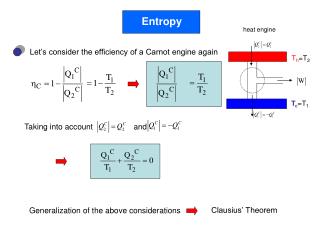
A Carnot cycle found a relationship between the temperatures and heat. The heat in and out are of opposite sign. Quantifying Quality
Closed Cycle • Any closed cycle can be approximated by a sum of Carnot cycles. • On a PV diagram this is any reversible cycle. • The heat to temperature ratios can be added.
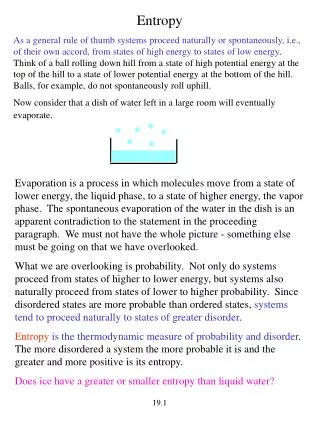
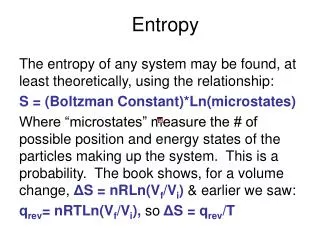
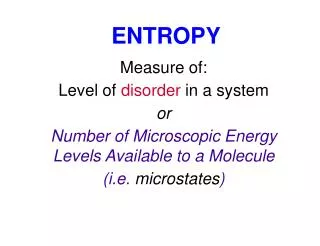
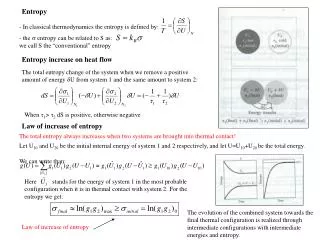
Entropy Defined • Entropy is defined as the heat flow at an absolute temperature. • The path doesn’t matter, so entropy is a macroscopic state variable.
The latent heat of ice is 79.7 kcal/kg. What is the change of entropy for a very slowly melting 1.00 kg piece of ice? What is the change in entropy for the surroundings? Find the heat transfer. Q = mL = 79.9 kcal Find the entropy change. DS = Q/T = 0.292 kcal/K The process is reversible. DSsurr = -0.292 kcal/K Melting Ice
A sample of 50.0 kg water at 20.0 C is mixed with 50.0 kg water at 24 C. Estimate the change in total entropy. Find the heat transfer. There are equal amounts of heat in each sample. Q = mcDT = 100. kcal Find the entropy change in each sample using the average temperature. DSH = Q/T = -100. kcal/296K = -0.338 kcal/K DSL = Q/T = +100. kcal/294K = +0.340 kcal/K The difference is the net change. DS = +0.002 kcal/K Mixing
Second Law III • The second law of thermodynamics can be described in terms of entropy: The entropy of an isolated system never decreases. It only stays the same for reversible processes.