Solving Equations Using Properties of Equality
Learn how to solve equations using Addition, Multiplication, and Division Properties of Equality. Explore interactive examples and practice problems to enhance your understanding.

Solving Equations Using Properties of Equality
E N D
Presentation Transcript
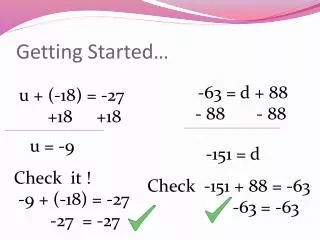
Getting Started… -63 = d + 88 u+ (-18) = -27 - 88 - 88 +18 +18 u= -9 -151= d Check it ! -9 + (-18) = -27 -27 = -27 Check -151 + 88 = -63 -63 = -63
Getting Started… • Which property can be used to solve the equation: x - 5 = 5 Addition Property Of Equality
Section 4.2 Multiplication and Division Equations
Definitions • Multiplication Property of Equality: • Division Property of Equality: For any numbers A, B, and C, if A=B, then A•C=B•C For any numbers A, B, and C, if A=B, then A÷C=B÷C
You want to give out lollipops to your friends at the lunch table. There are 8 kids at your table and you want to give out ALL 24 of your lollipops. How many lollipops will you give each friend? 3! 8 ∙ x = 24 8x = 24 8 8 Check: 8 * 3 = 24 x = 3
Try this one… -12 ∙ ∙ -12 -144 = y Check it :
Here we Go! • http://player.discoveryeducation.com/index.cfm?guidAssetId=254DB56E-59CB-44D2-977E-605BECA9F095&blnFromSearch=1&productcode=US
Two More to Try … 21 ∙ t = -336 21t = -336 ∙ -8 -8 ∙ 21 21 x = -32 x = -16 Check: 21 * -16= -336 Check it :