Early Design Process
This presentation focuses on the early design process for a pizza ordering system, emphasizing Human-Computer Interaction (HCI) principles. It covers user tasks, including ethnographic observation, scenario development, and task analysis. Key design guidelines from Shneiderman and Nielsen are highlighted, incorporating design metrics and heuristic evaluations. Participatory design is discussed to enhance user satisfaction, along with early evaluation techniques such as role-play and Wizard of Oz testing. The goal is to create a user-friendly interface that meets diverse user needs.

Early Design Process
E N D
Presentation Transcript
Early Design Process Chris North cs3724: HCI
Presentations • mohamed hassoun, • aaron dalton • Vote: UI Hall of Fame/Shame?
Today’s Excersize • Design a pizza ordering system
Review • Step1: • users • tasks • Task profiling • Design principles and guidelines • 5 HCI metrics • Shneiderman’s 8 golden rules • Nielsen’s 10 heuristics • Screen Layout • 3 UI Styles: • dm • menus • com lang
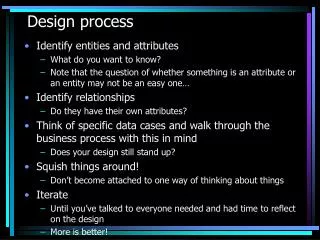
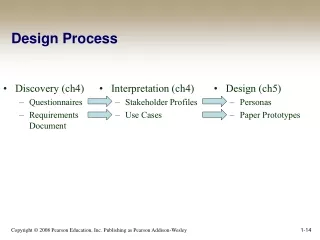
Early Design Process • 1. Users and Tasks • Interview users • Ethnographic Observation • Scenario development • User, Task analysis • Task profiling • 2. Design • Participatory Design • Shneiderman’s OAI: Map objects and actions • 3 UI styles, guidelines, standards • 3. Evaluate • Role Play • Wizard of Oz • Heuristic Evaluation
Interview Users • Fast • Cheap • College students
Ethnographic Observation • Watch users work • Record, analyze
Scenario Development • Write example scenarios of usage • Frat boy throwing party, needs lots of pizza & beer, he wants variety, slurred speech.
User and Task Analysis • Want pizza • 40% 2 person pizza, half/half • 10% Frat boy • Single user, simple meal: drink, how hungry? • Repetetive orders, every week, same as before, variations • Family dinner, # people, aduls vs chidren
Early Design Process • 1. Users and Tasks • Interview users • Ethnographic Observation • Scenario development • User, Task analysis • Task profiling • 2. Design • Participatory Design • Shneiderman’s OAI: Map objects and actions • 3 UI styles, guidelines, standards • 3. Evaluate • Role Play • Wizard of Oz • Heuristic Evaluation
Participatory Design • Users involved in designing UI • Good for very narrow user classes, tasks • E.g. a scientific discipline that’s hard for designers to understand • If user satisfaction is key • Advantages: • cover users concerns • Disadvantages: • Only covers concerns of participating users • Users don’t know HCI
Combo meal Combo meal Combo meal Whole, Half, quarter $8.99 peperoni
Early Design Process • 1. Users and Tasks • Interview users • Ethnographic Observation • Scenario development • User, Task analysis • Task profiling • 2. Design • Participatory Design • Shneiderman’s OAI: Map objects and actions • 3 UI styles, guidelines, standards • 3. Evaluate • Role Play • Wizard of Oz • Heuristic Evaluation
Early Evaluation • Role Play • Act out scenarios, gauge success • Wizard of Oz • Real users • Act out the system in response to users (don’t help them!) • Paper, stickies, blackboard, … • Heuristic Evaluation • Measure against 5 metrics, Shneiderman’s 8, Neilsen’s 10, Fitt’s law, …
Next • Hw2: • A-K: due today! • L-Z: due thurs • Midterm: feb 26 • Proj 2: design due feb 28 Presentations: proj1 design or UI critique • Thurs: nadine edwards, steve terhar • Next Tues: midterm • Next Thurs: peter hou