Download
1 / 27
280 likes | 418 Vues
This lecture explores number sequences, focusing on arithmetic and geometric series, their summation, and related concepts. It delves into how to find closed-form expressions for sums, illustrated with examples like the famous Gauss summation method. We also discuss annuities and present value calculations, comparing different repayment plans under various interest rates. The harmonic series and Stirling's formula are also introduced for estimating factorials. This integrated approach demonstrates the practical implications of these mathematical concepts in finance and algebra.

E N D
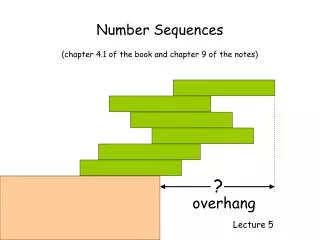
Number Sequences (chapter 4.1 of the book and chapter 9 of the notes) Lecture 5 ? overhang
Examples a1, a2, a3, …, an, … General formula 1,2,3,4,5,6,7,… 1/2, 2/3, 3/4, 4/5,… 1,-1,1,-1,1,-1,… 1,-1/4,1/9,-1/16,1/25,…
A Telescoping Sum When do we have closed form formulas?
Sum for Children 89 + 102 + 115 + 128 + 141 + 154 + ··· + 193 + ··· + 232 + ··· + 323 + ··· + 414 + ··· + 453 + 466 Nine-year old Gauss saw 30 numbers,each 13 greater than the previous one. 1st + 30th = 89 + 466 = 555 2nd + 29th = (1st+13) + (30th13) = 555 3rd + 28th = (2nd+13) + (29th13) = 555 So the sum is equal to 15x555 = 8325.
Arithmetic Series Given n numbers, a1, a2, …, an with common difference d, i.e. ai+1 - ai =d. What is a simple closed form expression of the sum? Adding the equations together gives: Rearranging and remembering that an = a1 + (n − 1)d, we get:
Geometric Series What is the closed form expression of Gn? xn+1 GnxGn= 1
Infinite Geometric Series Consider infinitesum (series) for |x|<1
The Value of an Annuity Would you prefer a million dollars today or $50,000 a year for the rest of your life? An annuity is a financial instrument that pays out a fixed amount of money at the beginning of every year for some specified number of years. Examples: lottery payouts, student loans, home mortgages. A key question is what an annuity is worth. In order to answer such questions, we need to know what a dollar paid out in the future is worth today.
The Future Value of Money My bank will pay me 3% interest. define bankrate b ::=1.03 -- bank increases my $ by this factor in 1 year. Soif I have $X today, One year later I will have$bX Therefore, to have $1after one year, It is enough to have bX 1. X $1/1.03 ≈ $0.9709
The Future Value of Money • $1 in 1 yearis worth $0.9709now. • $1/blast year is worth $1 today, • So $n paid in 2 years is worth $n/b paid in1 year, and is worth $n/b2today. $n paid k years from now is only worth $n/bk today
Annuities $n paid k years from now is only worth $n/bk today Someone pays you $100/yearfor10years. Let r ::= 1/bankrate = 1/1.03 In terms of current value, this is worth: 100r + 100r2 + 100r3 + + 100r10 = 100r(1+ r + + r9) = 100r(1r10)/(1r) = $853.02
Annuities I pay you $100/yearfor 10 years, if you will pay me $853.02. QUICKIE: If bankrates unexpectedly increase in the next few years, • You come out ahead • The deal stays fair • I come out ahead
Loan Suppose you were about to enter college today and a college loan officer offered you the following deal: $25,000 at the start of each year for four years to pay for your college tuition and an option of choosing one of the following repayment plans: Plan A: Wait four years, then repay $20,000 at the start of each year for the next ten years. Plan B: Wait five years, then repay $30,000 at the start of each year for the next five years. Assume interest rate 7% Let r = 1/1.07.
Plan A Plan A: Wait four years, then repay $20,000 at the start of each year for the next ten years. Current value for plan A = 114,666.69
Plan B Plan B: Wait five years, then repay $30,000 at the start of each year for the next five years. Current value for plan B = 93,840.63.
Profit $25,000 at the start of each year for four years to pay for your college tuition. Loan office profit = $3233.
Harmonic Number 1 Estimate Hn: 1 x+1 1 2 1 3 1 2 1 3 1 0 1 2 3 4 5 6 7 8
Integral Method (OPTIONAL) Now Hn as n , so Harmonic series can go to infinity!
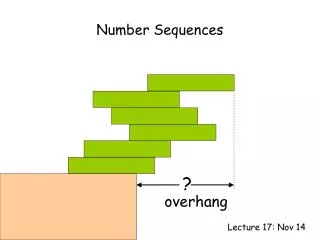
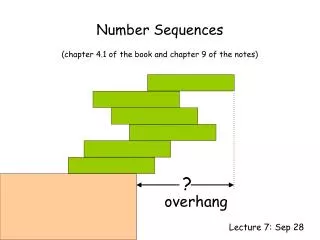
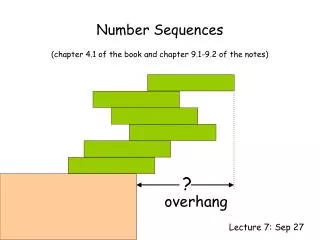
Book Stacking How far out? ? overhang
The classical solution Using n blocks we can get an overhang of Harmonic Stacks
Factorial Factorial defines a product: How to estimate n!? Turn product into a sum taking logs: ln(n!) = ln(1·2·3 ··· (n – 1)·n) = ln 1 + ln 2 + ··· + ln(n – 1) + ln(n)
ln(x) ln(x+1) ln n-1 ln n ln 5 ln 4 … ln 3 ln 2 Integral Method (OPTIONAL) ln n ln 5 ln 4 ln 3 ln 2 1 2 3 4 5 n–2 n–1 n
n n n ln(x) dx ln(i) ln (x+1)dx i=1 1 0 Analysis (OPTIONAL) Reminder: n ln(n/e) +1 ln(i) (n+1) ln((n+1)/e) +1 so guess:
Stirling’s Formula exponentiating: Stirling’s formula: