Understanding Periglacial Features: Formation, Examples, and Impacts on Landscapes
This article explores periglacial features and landforms shaped by frost action and mass movement in cold climates. It discusses the processes involved in the formation of patterned ground, frost heave, and solifluction, focusing on the dynamics of soil and rock affected by freezing and thawing cycles. Permafrost, defined as ground that stays below 0°C year-round, plays a crucial role in these formations. The article also includes links to visual resources and serves as a guide for exploring human adaptations in permafrost areas.

Understanding Periglacial Features: Formation, Examples, and Impacts on Landscapes
E N D
Presentation Transcript
IMAGE DESCRIPTION FORMATION EXAMPLES
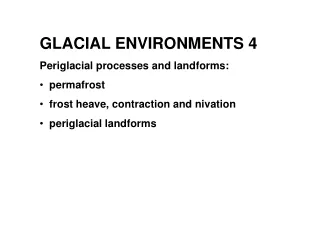
http://news.bbc.co.uk/2/hi/science/nature/2665675.stm • FROST HEAVE and PATTERNED GROUND
SOLIFLUCTION Mass movement of soil and loose rock particles affected by alternate freezing and thawing. Characteristic of saturated soils in high latitudes, both within and beyond the permafrost zone.
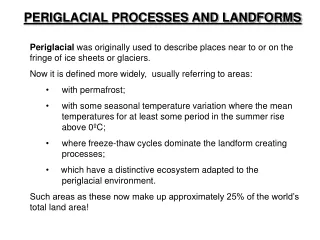
Permafrost • Permafrost is defined on the basis of temperature, as soil or rock that remains below 0°C throughout the year, and forms when the ground cools sufficiently in winter to produce a frozen layer that persists throughout the following summer. Talik is unfrozen ground that lies below the permafrost and between the active layer and permafrost.
Permafrost Map of Alaska • http://www.youtube.com/watch?v=rPzKgnTDhqA 01:00 to 03:30 • Watch remainder for homework. • Compare features of their journey to the permafrost map on handout. • Also, good links to human adaptation…