Understanding Graphics: From Pixels to Presentations in Digital Media
This guide covers various aspects of digital graphics, from the fundamentals of pixel representation in colors to advanced techniques in 3D modeling and animation. Explore bit-mapped and object-oriented graphics, the importance of resolution in print and display, and the role of photo management software. Learn about data compression methods and how CAD and CAM technologies revolutionize design and manufacturing. This comprehensive overview is essential for anyone looking to enhance their knowledge of digital imaging and presentation tools.

Understanding Graphics: From Pixels to Presentations in Digital Media
E N D
Presentation Transcript
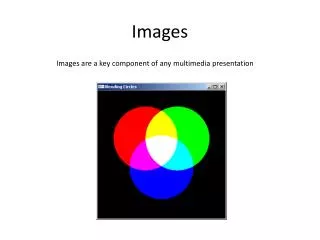
Screen Images • dots call pixels • each pixel is a colour. • colours = bit sequences. • more bits per pixel allow more colours. • bit depth / colour depth.
Bit Mapped Graphics • record colour to light each pixel. • 8 bit : 256 colours, or shades of grey. • 24 or 32 bits for photorealistic colour (millions for colours). • also called raster graphics. • bmp, tiff, jpg, gif, png. • Images from scanners, digital cameras.
Resolution • dots per inch. • 96 dpi looks good on the monitor. • printed images need more detail (higher resolution). • jaggies – low resolution. • 300 dpi : high quality printed image. • take up a lot of memory, can’t display every pixel at normal magnification.
Paint Programs • model an artists tools. • more sophisticated = more tools. • palette : selection of tools available. • not limited like the physical world.
Bit Mapped Graphics • created by paint programs, capture them using a digital camera or scanner. • photo-editing software to edit the images : • good : change lighting, reduce red-eye, cut people out. • bad : create images that aren’t true, but are incriminating.
Managing Photos • photo management software : iPhoto! PictureIt. • software often comes with your digital camera. • indexing and achieving digital images. • digital prints.
Object Oriented Graphics • clip art, line drawings, diagrams. • infinitively scalable. • not as much memory or storage. • can’t capture photo realistic detail. • instructions to draw the image. • postscript language, pdf files. • true-type fonts.
Data Compression • files can be large. • storage & network bandwidth. • lossy & loseless compression. • dictionary, more compact representation.
3D Modeling • virtual objects • rotate & explore • movies, commercials, simulated environments.
CAD / CAM CAD - Computer Aided Design • designers, engineers, architects. • designing products using a computer. • used to be just drafting tools, now include modeling tools : incorporate object properties like weight/mass or centre of gravity in the model.
CAD / CAM Computer Aided Manufacturing • computer guides the manufacturing. • program to create the product generated from the model.
Presentation Software • features to aid in lectures, talks, presentations, sales pitches, etc. • templates – layout & design to get you started. • bulleted lists, graphics, multimedia aspects (sounds, animations). • output – LCD projector, computer display, web, handouts, etc.
Animation • still frames shown in rapid succession: • animated GIFs • tweening / key frames. • algorithms for texture, lighting, etc. • vector graphics animation: • use objects like puppets • record events & interactions. • Macromedia Flash