Overcoming Challenges in Entrepreneurship Education: Insights from GEM at 15 Years
130 likes | 265 Vues
The 2012 GEM Annual Meeting focused on enhancing entrepreneurial education and fostering a sustainable ecosystem for entrepreneurs. Key topics included increasing the number and quality of entrepreneurs, developing crucial skills, and creating tailored educational programs for diverse stakeholders, including youth, women, and minorities. The agenda emphasized effective pedagogy, including mentorship and experiential learning, while sharing successful examples from global initiatives. This meeting aimed to inspire collaboration among educators, policymakers, and industry leaders to shape a proactive entrepreneurial landscape.


Overcoming Challenges in Entrepreneurship Education: Insights from GEM at 15 Years
E N D
Presentation Transcript
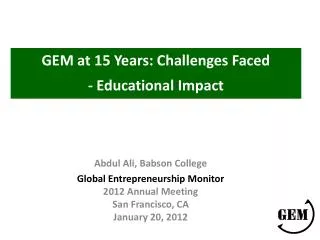
GEM at 15 Years: Challenges Faced - Educational Impact Abdul Ali, Babson College Global Entrepreneurship Monitor2012 Annual MeetingSan Francisco, CAJanuary 20, 2012
Agenda • Objective • Stakeholders • Content • Pedagogy • Insights • Examples • Action Plan
Objectives • Increase number of entrepreneurs/ intrapreneurs • Quantity and quality • Develop skills • Increase entrepreneurial orientation • Shape attitudes, knowledge, research • Create a sustainable entrepreneurship ecosystem • Awareness • Mentoring • institutions
Stakeholders • End Users (target audience) • Primary, secondary, and tertiary level • Women, youth, later life, minorities, displaced people, veterans • Non-business majors • Educators • Faculty development, • Parents • Employers • Financiers • Policy makers • NGOs, trade unions, aid agencies, chambers, etc. • Publishers, Media • Off-line, Internet
Content • Materials • Textbook, article, case, notes, videos, games • Slides, exercises • Best practices • Profit, non-profit, social • Data • Collection, analyses
Pedagogy • Educational practices • Lectures vs. experiential learning • Required vs. electives • Class, camp, workshop, seminar, competition, projects, simulation, fairs, business plan • Delivery • Assessment
Key Insights • Education • GEM data more suited to education than training • Training
Examples • YES (Youth Entrepreneurship Scheme) • Barbados Ministry of Education • 16 to 25 years old • Post high school one year program • Training and mentorship • Student Empowerment Entrepreneurship Development (SEED) program (West Indies) • Business Clinics • Business major students advising potential entrepreneurs
Examples • Slovakia • Business plan • Croatia and Netherland • Ph.D. program in Ent. & Innovation (Croatia) • Methodology course with GEM data • Scientific paper based on GEM data • Master Program in Netherlands • Customized programs • Degree and non-degree granting
Examples • Use GEM in the classroom • ET&P course, Entrepreneurship • context, activity, cross-country comparison • India, Panama, Venezuela • Junior Achievement Program • NFTE • Website • U.S. Dept. of Labor
Action Plan • Dedicated area in the GEM Website • Records, history, updates • Dissemination plan • Workshop, seminar for educators • Follow up • Outreach program • Information • programs • FAQs • stakeholders • Toolkits • Guidelines