
Understanding Biogenous and Hydrogenous Sediments in Marine Environments
This text explores the various types of ocean sediments, focusing on biogenous materials found in upwelling areas and hydrogenous sediments such as manganese nodules. It highlights the significance of carbonate sedimentation, including coccolithophores and foraminifera, and discusses how long biogenous materials take to settle. The composition of deep ocean floor sediments is examined, noting the abundance of clay, CaCO3 ooze, and silica across different oceanic regions, with insights specifically pertaining to locations like the southwest coast of South Africa and the White Cliffs of Dover.

Understanding Biogenous and Hydrogenous Sediments in Marine Environments
E N D
Presentation Transcript
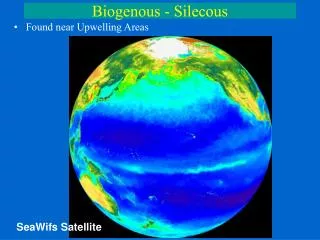
Found near Upwelling Areas Biogenous - Silecous SeaWifs Satellite
Found near Upwelling Areas Biogenous - Silecous SeaWifs Satellite
Found near Upwelling Areas Biogenous - Silecous South Africa: southwest coast
Biogenous - Carbonate Coccolithophore Foram (animal)
Biogenous - Carbonate Southern England: White Cliffs of Dover
How long do they take to settle? Biogenous Fecal Pellet: 0.008 in
Are source of oceanic hydrocarbons Biogenous
Lithogenous and Biogenous Deep ocean floor sediments (beyond continental margin) Clay is most abundant in Pacific CaCO3 ooze most abundant in Atlantic CaCO3 ooze most abundant in Indian World: Oceans: ~ 48% CaCO3, 38% clay, 14% silica ooze
Comes from dissolved material in the water Hydrogenous Sediments Manganese Nodules
Manganese Nodules Hydrogenous Sediments
Manganese Nodules Hydrogenous Sediments
Manganese Nodules Hydrogenous Sediments
Phosphorites Hydrogenous Sediments