Download
1 / 7
70 likes | 191 Vues
This article explores the configuration of electrons in energy shells, focusing on the electron's ground state and the principles governing electron arrangement. It explains the Aufbau principle, Pauli’s exclusion principle, and Hund’s rule, which dictate how electrons fill orbitals around an atom's nucleus. We break down the seven principal energy levels and their corresponding sublevels, including s, p, d, and f sublevels, detailing their shapes, orbital capacities, and the importance of superscripts in indicating electron occupancy.

E N D
Electron’s in Atoms How Electrons are Configured in Energy Shells
Electron’s Lowest State • The lowest energy arrangement of electrons is the most stable. When electrons are arranged in the lowest possible energy arrangement it is called the electron’s ground-state electron configuration.
Rules for Placing Electrons in Energy Shells • Three rules (principles) define how electronsare arrangedin orbit around an atom’s nucleus. • First Rule: • Aufbau’s principalstates that each electron occupies the lowest energy orbital available.
2nd & 3rd Rule • Pauli’s exclusion principalstates that a maximum of two electrons may occupy a single atomic orbital but only if they spin in oppositedirections. • Hund’s Rule states that single electrons with the same spin must each occupy an equal-energy orbital before additional electrons with different spins can occupy the same orbitals.
Energy Levels & Sublevels • There are seven principal energy levels (shells). • Each principal energylevel contains sublevels. • Each sublevel contains orbitals. The orbitals are where the electronsreside. • Each orbital allows only two electrons.
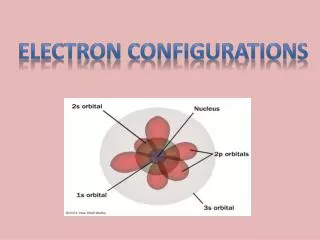
s & p Sublevels • The sublevels are designated s, p, d and f. • The s sublevels are spherical, contain one orbital, and can hold a total of twoelectrons. • The p sublevels resemble dumbbells. There are three p orbitals each allowing two electrons. The total number of electrons able to occupy the p sublevels is six.
d & f Sublevels • The shapes of the d and the f sublevels become more complicated. The d sublevels have fiveorbitalsand can hold a maximum of 10 electrons while fsublevels contains 7 orbitals and can hold a maximum of 14 electrons. • The superscripts inform us how many electrons are residing in an orbital.