Kenya Design Project
This project presents a detailed analysis of sustainable energy options in Kenya, focusing on the development of an ethanol cooker as a solution to existing environmental and economic challenges. By aiming for over a 50% reduction in fuel usage and emissions, we highlight the importance of shifting traditional cooking practices to eco-friendly alternatives. The project explores various technologies such as solar, geothermal, and advanced ethanol refinement, emphasizing economic viability, labor costs, and the potential for improving livelihoods in rural communities.


Kenya Design Project
E N D
Presentation Transcript
Kenya Design Project Angela Buck Alex Ortega Josh Klajnowski KrystenRozanski
Table of Contents • Background information • Environment • Economy • Culture • Current Technology • Goals • Brainstorm • Evaluation • Design Matrices • Proposed Solution • Business Plan
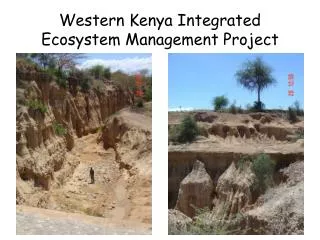
Environment Climate- 70 degrees year round Rainy seasons occur from April to June and October to December Deforestation has become a problem in Kenya
Economy • Market based economy and an external trade system • 80% of Kenyans live off of their land • 14% work in industry • Average earnings 9,000-15,000 shillings per year, or $121.00-$201.00
Culture • 85% of females buy and cook the food for their families • Boys are raised to take care of animals, while girls are raised to work on the farm • 85% of total population older than 15 years old are literate • Average family consists of two parents and 4-5 children
Fuels • Geothermal • Electricity • Charcoal • Kerosene • Ethanol • Solar • Wood Current Technology Jico Envirofit
Goals • Greater than a 50% decrease in emissions • Greater than a 50% decrease in fuel usage • Greater than a 50% decrease in cooking cycle time • More sustainable (economic, social, and environmental)
Brainstorming • Ethanol Cooker • Solar Cooker • Upgraded Jico • Geothermal Cooker • Electric Cooker
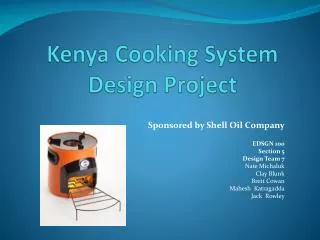
Ethanol Cooker • Many benefits • Decreases cooking time (takes approximately 8 minutes to boil water) • Burns more efficiently than Kerosene and Propane which are all more efficient than what is already used • Reduces emissions by 40% • 3 gallon tank
11” tall • Tank height 6” • CC height 5”
Tank Diameter 12” CC Diameter 10”
Our Business Plan • Refine the ethanol without money payment • Keep small percentage of each gallon produced as refining fee • Sell that ethanol to urban areas • Sell DDGS to farmers for animal feed
Cost Estimate • Cost of Production: • Cast Iron: $1.88 • 0.038 ft^3, 17.12 lbs, $0.11/lb • Labor Cost: Average Kenyan paid $0.33 per day Expected cost of labor: $0.17 • Shipping costs: $4.00 • Other factors (electricity, equipment, repairs, etc.): $5.00 • Total Estimated Cost: $11.05 • Expected Retail Value: $12.00-$15.00