Download
1 / 17
190 likes | 341 Vues
Cougars, also known as Mountain Lions, Pumas, and Deer Tigers, are fascinating members of the Felidae family. With males weighing between 150-220 lbs and females 95-110 lbs, these shy and elusive carnivores are renowned for their unspotted pelage, ranging from brown to silver. Once dominantly spread across the Americas, their population has drastically decreased, now classified as endangered. Cougars typically inhabit various environments, from tropical rainforests to deserts. Despite facing human threats, they continue to adapt and survive, raising cubs under the careful guidance of their mothers.

E N D
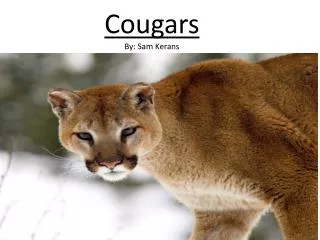
Cougars By: Sam Kerans
Classification • Kingdom: Animalia • Phylum: Chordata • Class: Mamilia • Order: Carnivora • Family: Felidae • Genus: Felis Concolor • Species: Felis Concolor • Cougars are related to all cats and are also called: Mountain Lions, Pumas, and Deer Tiger.
P U M A M O U N T A I N L I O N C O U G A R
Physical Characteristics • Very shy and timid • Males weigh from 150-220 lbs. • Females weigh from 95-110 lbs. • Males and females look almost exactly alike • Grow to a length of 7 ½ feet • Pelage is unspotted, varying from brown to silver • Have blue eyes and rings around their tails when born • Have very small heads • Consistent diet of meat
Distribution • Used to have huge distribution • Gone down drastically in past couple years • Now in North and South America • Mostly in Western Hemisphere • Had biggest distribution of all mammals • Now one of the medium sized ones
Habitat • Habitat depends greatly on where it is • Don’t have one particular habitat • Wide tolerance going in all directions • Frequent use of dens and caves • Live mostly in tropical rainforests or dry deserts • Space themselves so they can have easy access to food, water, and other essential needs • Decides home on vision, smell, and hearing
Conservation Status • According to IUCN Red List Cougars are endangered • Their numbers used to be decreasing but are staying pretty stable now • Almost 2,000 cougars are shot every year • There are still plenty of them out there but their numbers shouldn’t be this low
Reproductive Characteristics • Give birth in late spring • Litters can have 1-6 cubs, but average is 3-4 • Start mating at 3 years old
Parent Care • Babies stay with their parents till they are about 1 ½ to 2 years old • Only the mother takes care of the babies • Mother teaches them everything the need to know to survive on their own
Longevity & Mortality • Generally live 10-15 years of age • Males and females usually live the same amount of years • In captivity cougars live to be 20 years old
Seasonal Patterns • Cougars do not hibernate • They also do not migrate • Neither do the undergo torpor
Diet • Cougars are carnivores so they only eat meat • Their diet consists of: elk, moose, deer, etc.
Predator Relationship • Humans are the cougar's main predators. • Predators are jaguars, bears, wolves, wolverines, alligators, and other cougars for food and territory • These animals are a big threat to cougars conservation status
Human Relationship • Not fond of humans • Very shy and timid when around us • Only contact humans have with cougars are in zoo’s and captivity
Fun facts • Their long limbs allow them to cover a distance 40 feet in a single leap • the Cougar is known by a number of names like panther, puma, Florida Panther, Catamount, Mountain Lion and Mountain Screamer. • Not social creatures. They are very reserved animals
Works Cited Cougars (Mountain Lions) - Living with Wildlife. Russell Link, n.d. Web. 15 Feb. 2013. <http://wdfw.wa.gov/living/cougars.html>. Mountain Lions. National Geographic, n.d. Web. 15 Feb. 2013. <http://animals.nationalgeographic.com/animals/mammals/mountain-lion/>. Read, Tracy C. Exploring the World of Cougars. Buffalo: Firefly Books Ltd., 2011. Print. Stone, Lynn M. Cougars. Minneapolis: Carolrhoda Books, Inc., 1999. Print.