Perspectives on Flag Burning and Privacy Rights in Constitutional Context
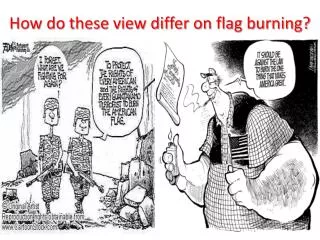
This discussion delves into the differing viewpoints on flag burning, particularly the American flag, and the legal implications surrounding it, including the boundaries of freedom of expression. It further explores various types of speech, from pure and symbolic speech to seditious and defamatory speech. Additionally, the conversation extends to the right to privacy in the digital age, questioning expectations of privacy on social media and the implications for employment, touching upon landmark cases including Griswold, Roe, and Katz, and the evolution of privacy rights under the Constitution.

Perspectives on Flag Burning and Privacy Rights in Constitutional Context
E N D
Presentation Transcript
What reasonable consequences might one face for their expression
Freedom of Expression • Types of Expression: • Pure speech: spoken word, verbal expression • Symbolic speech: expressive action • Seditious Speech: challenges authority • Defamatory speech: false speech • Slander: spoken • Libel: written • Obscenity: offensive speech • Commercial Speech • Political Speech
Is it reasonable to expect privacy on social networking sites?
Should allowing access to your Facebook account be a condition of employment?
Right to Privacy? • Constitutional Right? • Not Enumerated: • 1st, 3rd, 4th, 5th, and 9th Amendment • Griswold and Roe • Katz • 4th protects people not places • Dissent: 4th refers to tangible items
Cases • Olmstead v. US (1929) • Eavesdropping in public area • Katz v. U.S. (1967) • Expectation of privacy in public (people not places) • Griswold v. Conn. (1965) • Use of contraception (consenting adults in the home) • Roe v. Wade (1973) • Right to abortion protected • Ouinlan (1976) & Cruzan (1990) cases • Right to refuse treatment, must have “clear and convincing evidence” it was their wish • Washington v. Glucksburg (1997) • No right to suicide • Lawrence v. Texas (2003) • Sodomy laws unconstitutional (consenting adults in the home) • Gonzales v. Oregon (2006) • Legality of physician assisted suicide left to states