Understanding DC Motors: Principles of Electromagnetic Energy Conversion
This text provides an overview of the fundamental principles behind DC motors, focusing on how magnetic fields interact to convert electrical energy into mechanical energy. It discusses how the application of current to the field and armature causes the conductor to move from regions of weak to strong magnetic fields. The importance of reversing current flow for continuous rotation is explained, alongside details of conductor motion within magnetic fields. Different motor types, including series, shunt, and compound wound configurations, are introduced, emphasizing the significance of winding size and turns in maximizing torque and efficiency.

Understanding DC Motors: Principles of Electromagnetic Energy Conversion
E N D
Presentation Transcript
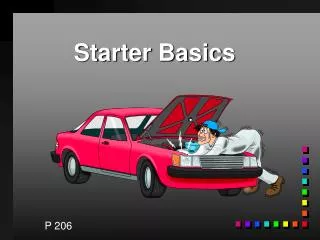
Starter Basics P 206
Motor Principles • DC motors interaction of magnetic fields to convert electrical energy to mechanical energy • Current is applied to field and armature • Conductor tends to move from weak magnetic field to strong magnetic field. • For armature to continue rotating, the current flow must be reversed.
Conductor Current • Conductor has magnetic flux lines around it • Opposes north and south fields which causes loop of wire to turn. Page C138
Magnet • Has north and south pole. • Magnetic lines of force move from north to south pole. Page C138
Conductor in Magnetic Field • As current travels through conductor and fields, conductor moves. PAGE C138
Flux lines always tend to want to be straight • Fields act on each other
ROTATION OF CONDUCTOR IS IN DIRECTION OF WEAKER FIELD. PAGE C139
Electromagnetic Motor Page C139
Made of Laminated Core • Solid Steel Shaft • Commutator • Lap and Wave Wound (P C141)
Stationary Field Windings • Iron Core & Windings concentrate magnetic field • Fields have north and south pole based on direction windings are wound around pole shoes
3 Methods of Connecting Fields • Series Wound • Maximum torque when starts • Shunt Wound • Used in smaller motors • Compound Wound • Constant speed Page C143
The power is in the size of the windings, the size of the windings, the number of turns and how its wound
PERMANENT MAGNET STARTER MOTOR • Has no field circuit • Very light weight • Usually gear reduction starter motors • Fairly fragile • Permanent magnets are stronger than typical permanent motors (Made of boron, neodymium and iron)