What is an Adjective
Hereu2019s the most precise guide ever on what adjectives are, their usage, and placement. Youu2019ll never make a mistake with using adjectives in your writing ever again.


What is an Adjective
E N D
Presentation Transcript
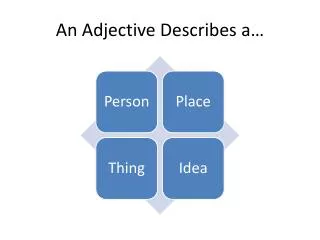
What is an Adjective? If you are new to learning the English Language and Grammar basics, you have come to the right place. Have you been wondering what an adjective is? How to use it properly in a sentence? What are the different types of adjectives? In this article, you will learn all there is to know about “Adjectives Adjectives.” Adjectives are used to describe the qualities of nouns or noun phrases. They are further divided into thirteen different types. Adjectives were considered one of the most important parts of speech in the English language. Originally, they were classified with nouns. However, a few
words initially classified as adjectives have now been renamed as determiners, including words like a, the, this, and them, etc. Definition: The Merriam-webster dictionary has defined adjectives as: “A word that describes a noun or a pronoun” “A word belonging to one of the major form classes in any of numerous languages and typically serving as a modifier of a noun to denote a quality of the thing named, to indicate its quantity or extent, or to specify a thing as distinct from something else.” Blue Blue Bird, Beautiful Beautiful Poem, and Strong Strong Morals, here Blue, Blue, Beautiful Beautiful, and Strong Strong are the “adjecti adjectives ves” in each, and they can be seen enhancing the meaning of nouns followed by them, i.e., Bird, Poem, and Morals. Examples of Adjectives: Here’s a list of 10 words that can be used as adjectives: Dark Handsome Yellow Elegant Delicious Tall Stronger Delicious Sturdy Happy Examples of Adjective in Sentences: To further clarify what adjectives are, let us go through a few sentences consisting of adjectives: 1.Ed is stronger stronger than Ned.
2.This is a strong strong and sturdy sturdy table. 3.She wore an elegant elegant dress at the gala. 4.Natalie was wearing a gorgeous yellow gorgeous yellow sweater. 5.The tall, dark, tall, dark, and handsome handsome prince came to the princess’s rescue. All the words in bold are “adjectives adjectives” as they modify the quality of the nouns in the sentences. Types of Adjectives 1. Comparative Adjectives Comparative adjectives are used to compare two nouns. They amplify the quality of one noun as compared to the other. When we use comparative adjectives, it is impossible not to use “than.” For Example: For Example: This dress is prettier prettier than the other one. She is much quieter quieter as compared to her sister. Healthier, prettier, and quieter are comparative comparative adjectives adjectives in these sentences. Besides these, a few irregular comparative adjectives include better, worse, elder, and further.
2. Superlative Adjectives When something is of the highest degree/quality compared to the other, we use the superlative form of adjectives. For Example: For Example: He has the highest highest grades in the class. Bananas are one of the healthiest healthiest snacks. Adam just told me the saddest saddest piece of news ever! Lee is the most genuine most genuine person in our friend circle.
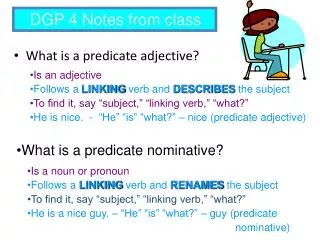
3. Predicate Adjectives The adjectives that don’t come right before the noun/noun phrase, but at the end of the sentence, joined to the noun with a linking verb, are called predicate adjectives. For Example:Possessive For Example:Possessive- -Adjective Adjective My landlord is rich rich and frivolous frivolous. The sun was shining bright bright.
4. Compound Adjectives Adjectives consisting of multiple words joined together by a hyphen (or not) are called compound adjectives, like well-written, happy-go-lucky, world- famous, etc. Remember that compound adjectives will always be placed right before the word they will be modifying. For Example: For Example: Britney has such a happy happy- -go go- -lucky lucky personality. She presented a well well- -researched researched idea.
They can also be written without hyphens, but you will need to put inverted commas around them. For Example: For Example: Nobody liked Sheldon and his “holier than thou holier than thou” attitude. Or proper nouns can also at times be used as compound adjectives, but then the first words are always capitalized for each word. For Example: For Example: This movie had such a Breakfast Club Breakfast Club feel.
5. Possessive Adjectives As evident by the name, adjectives used to show possession, ownership, or belonging are known as possessive adjectives. They usually are words like; mine, his, her, our, their, etc., and correspond to pronouns like Me, I, He, She, Them, etc. Fo For Example: r Example: Ally narrated her her poem to the audience. This family business is their their legacy. Welcome to our our house.
6. Demonstrative Adjectives The adjectives that describe the location or position of something or someone in space or time are known as demonstrative adjectives. They are placed right before the noun or noun phrase they are modifying. These include; this, these, that, and those, Some might say the ordinal numbers are also demonstrative adjectives. And it is true, as they also describe the location of something in series, i.e., 1st, 2nd, 3rd,…/First, second, third, and so on. For Example: For Example: These These tables are reserved for the VIPs.
This This coat is my favorite piece of winter clothing. Those Those couple of days were the worst time of my life. 7. Proper Adjectives Proper adjectives originate from proper nouns. They can originate from proper names or places. For example, the Victorian the Victorian Era describes the period when Queen Victoria ruled Britain. Another example can be Chinese Chinese Cuisine, which originates from China. For Example: For Example: The collection consists of very Victorian Victorian gowns. My father is Iranian Iranian, whereas my mother is German German.
8. Participial Adjectives Principal adjectives are identical in form to participles. To understand them better, it’s better if you look at past and present participles. Usually, the words ending with “-ed” or “-ing” are participles. However, when we use participles as adjectives (modifying nouns/pronouns), they are called participle adjectives. For E For Example: xample: I forgot my running running shoes at home. My sleeping sleeping pajamas are all worn out.
Like other adjectives, participle adjectives are placed right before the noun or pronoun it is modifying. It can also be used as a subject complement, followed by a linking verb. For Example: For Example: I passed my driving driving test today. (Here, “driving driving” is the participle adjective placed directly before the noun “test”). The movie was boring boring.
(Here, the participle adjective “boring boring” is used as a subjective complement, linked with the subject by the linking verb “was.” 9. Limiting Adjectives A limiting adjective is what we can call the opposite of a descriptive adjective. Just like descriptive adjectives modify a noun or pronoun by describing it, the limiting adjective modifies a noun or pronoun by limiting it. A few limiting adjectives include; some, few, any, several etc. Few grammarians think that the following adjectives also fall under the criteria of limiting adjectives, as they do not describe anything specific of the noun/pronoun; demonstrative demonstrative (this, that, these, those), interrogative interrogative (whose, which, what), quantifying quantifying (many, some, few, couple, cardinal/ordinal numbers), and possessive possessive adjectives (mine, yours, their, his), as well as articles articles (a, the, an). For Example: For Example: Her show starts in a couple of couple of hours. My best friend has some extra passes, but they are a few few in number. She went missing for several several hours, and we all got so worried for her.
10. Descriptive Adjectives Adjectives that modify a noun or pronoun by defining its quality are described as descriptive adjectives. For Example: For Example:
My mother is a very elegant elegant lady. They are placed before the noun or pronoun they modify or as a subject complement after the noun. However, you might be wondering, “isn’t that what all adjectives do? Describe the quality of a noun/pronoun?”. But we know that is not true, as we discussed above in limiting adjectives. 11. Interrogative Adjectives The adjectives that modify a noun or pronoun by asking a question about it are interrogative adjectives. These are usually used to ask questions about a noun/pronoun in a sentence.
The commonly used adjectives include: what, whose, which. Their placement is usually at the beginning of a sentence or sometimes within the middle of a sentence. For Example: For Example: I need to figure out whose whose bag it is. Although whose is a possessive pronoun, it can also be used interchangeably as an interrogative adjective. 12. Attributive Adjectives
An adjective placed right next to the noun or pronoun it is modifying is an attributive adjective. These adjectives don’t let any linking object get in between them. They can be placed right before or after the noun, i.e., postpositively, but they are never apart, unlike the predicate adjectives. For Example: For Example: Mary bought something special special for her best friend. 13. Distributive Adjectives
The adjectives used to refer to individual members of a group are called distributive adjectives. They include words like: each, every, any, either/neither, both. They are placed before the nouns or pronouns they are modifying. Usually, they can be placed at the beginning of the sentence. For Example: For Example: The trophies were given to each each participant in the delegation. I gave presents to every every child in the room.
Difference between Adjective and Determiner: Conclusion: Let’s end with a few words on the importance of adjectives. Adjectives can make or break the quality of your writing. Therefore, it’s not only important to know the usage and correct placement of adjectives, but we also need to know when using or skipping them is ideal for your text. For instance, when I say “I bought a pink dress pink dress,” “pink” is important because it conveys an important piece of information. However, if I say “It’s a very big big house,” the choice of adjective is poor because it is better conveyed with an appropriate noun, e.g., “It’s a Mansion.” Therefore, when writing, we need to make an effort to choose our adjectives properly, or our text might come off as amateur or cluttered.Don’t fret though, if you want to learn proper English writing, speaking, and listening skills, MTS has got you covered with our excellent English Tutors. They can help you improve your grammar, punctuation, and pronunciation skills.