Download
1 / 17
170 likes | 298 Vues
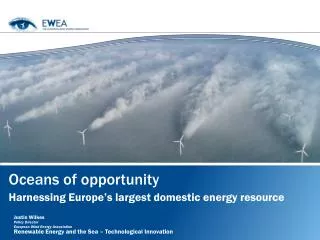
This report highlights the enormous potential of offshore wind energy as Europe's largest domestic energy resource. With a cumulative installed capacity projected to reach 150 GW by 2030, offshore wind can significantly meet the EU's electricity demands while reducing greenhouse gas emissions. The report outlines the necessary infrastructure, market growth, and investment strategies to develop this resource, ultimately making a sustainable electricity market accessible to all EU consumers and enhancing energy security across the region.

E N D
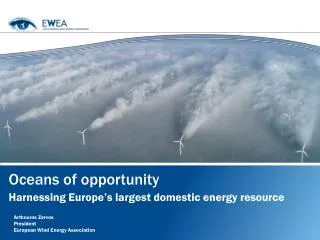
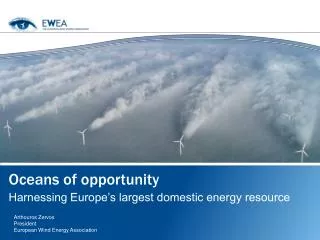
Oceans of opportunity Harnessing Europe’s largest domestic energy resource Arthouros ZervosPresident European Wind Energy Association
Global cumulative wind power capacity 1990-2007 (MW) Offshore wind can power Europe seven times over • Technical potential of offshore wind • 25,000 TWh by 2020 • 30,000 TWh by 2030 • EU energy demand • 3,537 TWh by 2020 • 4,279 TWh by 2030 Source: European Environment Agency
Global cumulative wind power capacity 1990-2007 (MW) Eight offshore wind farms could produce all the EU’s electricity Eight 100x100 km offshore wind farms could produce 3,000 TWh – equivalent to EU power demand Source: Siemens
Offshore – current status End 2008: 1.5 GW offshore – 8 EU countries
Global cumulative wind power capacity 1990-2007 (MW) 2008 and 2009: steady as she goes • 2008: • 366 MW annual installed offshore capacity • 1,471 MW cumulative installed offshore capacity • 2009: • 420 MW annual installed offshore capacity • 2,000 MW cumulative installed offshore capacity
Global cumulative wind power capacity 1990-2007 (MW) Offshore wind energy market in the EU in 2010 • Annual installations of 1,100 MW • Cumulative installed capacity of 3,000 MW • Electricity production of 11 TWh • Meeting 0.3% of total EU electricity demand • Avoiding 7 Mt of CO² annually • Annual investments in wind turbines of €2.5 billion
Global cumulative wind power capacity 1990-2007 (MW) 100 GW and counting • EWEA has identified proposals for over 100 GW of offshore wind projects in European waters: • 100+ GW would meet 10% of EU electricity demand • 100+ GW would avoid 200 Mt of CO² annually • 100+ GW shows the significant level of developer interest • EWEA‘s prediction: 40 GW by 2020 • 150 GW by 2030
Global cumulative wind power capacity 1990-2007 (MW) EWEA report
Global cumulative wind power capacity 1990-2007 (MW) Offshore wind energy market in the EU in 2020 • Total installed capacity of 40,000 MW • Annual installations of 6,900 MW • Electricity production of 148 TWh • Meeting between 3.6% and 4.3% of total EU electricity demand • Avoiding 85Mt of CO² annually • Annual investments in wind turbines of €8.8 billion
Global cumulative wind power capacity 1990-2007 (MW) Offshore wind energy market in the EU in 2030 • Total installed capacity of 150,000 MW • Annual installations of 13,690 MW • Electricity production of 563 TWh • Meeting between 12.8% and 16.7% of total EU electricity demand • Avoiding 292 Mt of CO² annually • Annual investments in wind turbines of €16.5 billion
Global cumulative wind power capacity 1990-2007 (MW) Offshore market growth can repeat follow onshore growth levels Historical onshore growth 1992-2004 compared to EWEA‘s offshore projection 2008-2020 (MW) • onshore market growth: 32% • offshore market growth: 28% Source: EWEA 2009
Global cumulative wind power capacity 1990-2007 (MW) EWEA’s 20 year offshore network development plan • Contains the grid updates needed to transport all electricity produced by planned, proposed, under construction and operating offshore wind farms to European electricity consumers in an economically sound way • Recommends building transnational offshore grid infrastructure to connect40 GW by 2020 150 GW by 2030
Global cumulative wind power capacity 1990-2007 (MW) EWEA’s 20 year offshore network development plan • Based on: • Existing TSO plans • TradeWind scenarios • Added value of plan: • - Provides step by step timetable for grid development • Suggested capacities • Integrated with development/concession zones
Global cumulative wind power capacity 1990-2007 (MW) EWEA’s 20 year offshore network development plan Source: EWEA 2009
Global cumulative wind power capacity 1990-2007 (MW) Building the European offshore grid Benefits • Predictable energy output • Connections to more than one country • Power trading between countries • Viable alternative to onshore grid construction • Connection to other marine renewable energy sources • More economical utilisation of grid through shared use • More energy security • More interconnection capacity means more firm power • Building a single European electricity market would benefit all consumers
Global cumulative wind power capacity 1990-2007 (MW) EWEA report
Thank you very much for your attention www.ewea.org/offshore RENEWABLE ENERGY HOUSE 63-65 RUE D’ARLON B-1040 BRUSSELS T: +32 2 546 1940 F: +32 2 546 1944 E: ewea@ewea.org