1 / 2

Bioplastic Packaging Market

The Bioplastic Packaging Market centers on eco-friendly packaging materials made from renewable biomass sources, such as corn starch, sugarcane, and cellulose.

Aparna54
Télécharger la présentation

Bioplastic Packaging Market

An Image/Link below is provided (as is) to download presentation Download Policy: Content on the Website is provided to you AS IS for your information and personal use and may not be sold / licensed / shared on other websites without getting consent from its author. Content is provided to you AS IS for your information and personal use only. Download presentation by click this link. While downloading, if for some reason you are not able to download a presentation, the publisher may have deleted the file from their server. During download, if you can't get a presentation, the file might be deleted by the publisher.

E N D

Presentation Transcript


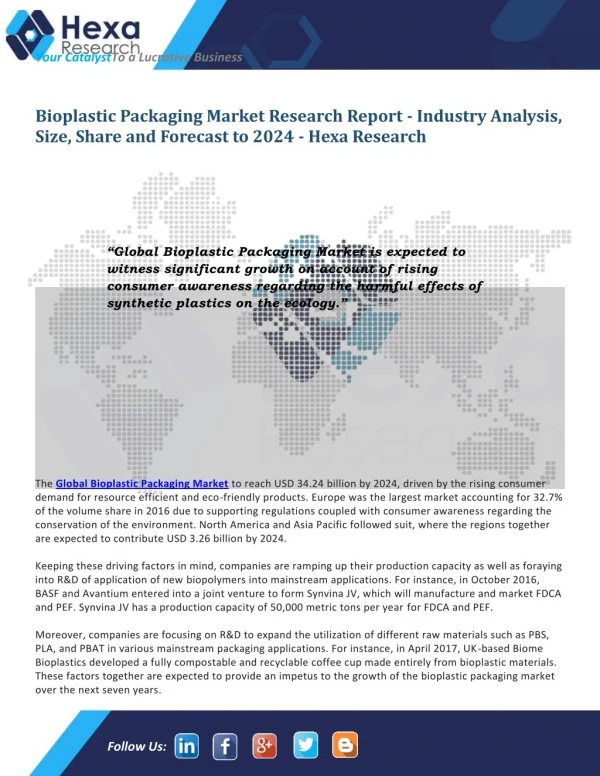
  1.    +1 217 636 3356 +44 20 3289 9440 sales@mobilityforesights.com    Your Cart 0   Company Market Reports Consumer Research Advisory Services Exports - Imports Careers Contact Us Blog Your cart is empty Your Name Return to Shop Business Email Global Bioplastic Packaging Market 2024-2030 Country Phone Number +1 Company Name Single User License : $ 3,500 Your message Corporate User License : $ 6,000 By submitting this form, you are agreeing to the  Request Sample Terms of Use and Privacy Policy. I'm not a robot reCAPTCHA Privacy - Terms BUY NOW DOWNLOAD SAMPLE DESCRIPTION TABLE OF CONTENTS BIOPLASTIC PACKAGING MARKET INTRODUCTION Bioplastic packaging is the term for materials made of renewable resources that are both biodegradable and compostable that are used to make packaging. Due to its non-biodegradable nature, contribution to pollution, and accumulation of trash, conventional plastic packaging, which is derived from fossil fuels, has caused serious environmental issues. Packaging made of bioplastics provides an option that tries to lessen the environmental impact caused by traditional plastics. Renewable materials including maize starch, sugarcane, wheat, and vegetable oils, among others, are used to make bioplastics. These components are converted into polymers, which are then utilized to make a variety of packaging items, such as bags, films, containers, trays, and bottles. There are two primary categories of bioplastics: compostable and biodegradable. Biodegradable bioplastics are made to spontaneously decompose into less complex materials through biological processes, such as the action of microbes. Polymers like polylactic acid (PLA) or polyhydroxyalkanoates (PHA) are frequently used to create them. When a product has a short shelf life, biodegradable bioplastics may be an appropriate choice for short-term packaging applications. Contrarily, compostable bioplastics are created to decompose in a specialized composting environment. They decompose into carbon dioxide, water, and biomass, leaving no observable or hazardous remnants behind. Typically, biodegradable polymers and renewable resources are combined to create compostable bioplastics. They are appropriate for a variety of packaging uses, such as single-use items and food service items. Comparing bioplastic packaging to traditional plastic packaging, there are several environmental benefits. First off, because they are made from renewable materials, bioplastics help to combat climate change by reducing reliance on fossil fuels. Additionally, because some varieties need less energy than conventional plastics, bioplastics have the potential to lower carbon emissions during manufacture. Bioplastics also have the benefit of being compostable or biodegradable. This implies that they will naturally degrade if they We use cookies to understand site usage and improve content and offerings on our site. To learn more, refer to our Privacy Policy. By continuing to use this site, or closing this box, wind up in the environment as trash, lowering their persistence and possible harm to ecosystems. 0  It is important to remember that bioplastic frequently needs particular conditions for optimal degradation, such as commercial Learn more you consent to our use of cookies. composting facilities or particular temperatures and humidity levels. Bioplastics may behave similarly to conventional plastics as a result of improper disposal, which would negate the objective of using them. Got it! Send message Continue Shopping Additionally, bioplastic packaging presents prospects for waste reduction. For instance, some bioplastics, like PLA, can be made from waste materials from other industries, including the processing of corn or sugarcane. Utilizing these byproducts can help bioplastic production support a circular economy strategy by reducing waste and effectively using resources. However, it’s crucial to take into account any potential disadvantages of bioplastic packaging. The conflict between growing crops for food production and those used to make bioplastics on land is one thing to be concerned about. This problem emphasizes the requirement for sustainable land management and sourcing methods to guarantee the long-term survival of bioplastics. Infrastructure is yet another factor to take into account when disposing of and recycling bioplastics. While certain bioplastics can be recycled with conventional plastics, others would need to be collected separately or handled in facilities designed specifically for composting or industrial composting. Maximizing the environmental advantages of bioplastics requires the construction and expansion of such infrastructure. As a promising replacement for conventional plastic packaging, bioplastic packaging is offered. Bioplastics, which are made from renewable resources, can lessen reliance on fossil fuels and help to slow down global warming. Bioplastics that are compostable and degradable offer green alternatives for a variety of packaging uses. To optimize the advantages and reduce any potential disadvantages of bioplastic packaging, effective waste management, and infrastructure development must be ensured. BIOPLASTIC PACKAGING MARKET SIZE AND FORECAST The Global Bioplastic Packaging Market accounted for $XX Billion in 2022 and is anticipated to reach $XX Billion by 2030, registering a CAGR of XX% from 2024 to 2030. NEW PRODUCT LAUNCH  Too reduce trash, TIPA Corporation Ltd. teamed up with Amcor to produce compostable packaging in Australia and New Zealand. In exclusive cooperation with TIPA, Amcor will produce, provide, and distribute the product, which will include fresh food and bakery goods, and eliminate the need for conventional plastic bags and packaging from the waste stream. In January 2021, Taghleef Industries expanded its selection of biobased polypropylene (PP) films. The bio-based alternatives to films made from fossil fuels offered by Taghleef are biodegradable packaging possibilities. The biobased PP films from Ti that have received ISCC Plus certification can be used for the same packaging and labeling purposes as standard grades made from fossil-based raw materials. MARKET DYNAMICS By putting the European Green Deal into practice, the European Union (EU) is working toward the 2050 net-zero emissions target and addressing the growing environmental and sustainability crisis. The manufacture, usage, and disposal of plastic in the European economy are all linked to the desire for a more sustainable society. With the largest market for bioplastics in the world, Europe strengthened its position as the industry’s global hub and ranked first in research and development. Currently, Europe is home to one-fourth of the world’s bioplastics production capacity.

  2. Additionally, customers in the area are becoming more and more aware of how plastic and non-biodegradable packaging affects the environment. In this nation, there is a growing demand for eco-friendly packaging, particularly packaging made of bioplastics. COMPANY PROFILE Biome Bioplastics BASF Braskem Innovia Films Natureworks THIS REPORT WILL ANSWER THE FOLLOWING QUESTIONS 1. How many Bioplastic Packaging are manufactured per annum globally? Who are the sub-component suppliers in different regions? 2. Cost breakup of a Global Bioplastic Packaging and key vendor selection criteria 3. Where is the Bioplastic Packaging manufactured? What is the average margin per unit? 4. Market share of Global Bioplastic Packaging market manufacturers and their upcoming products 5. The cost advantage for OEMs who manufacture Global Bioplastic Packaging in-house 6. key predictions for the next 5 years in the Global Bioplastic Packaging market 7. Average B-2-B Bioplastic Packaging market price in all segments 8. Latest trends in the Bioplastic Packaging market, by every market segment 9. The market size (both volume and value) of the Bioplastic Packaging market in 2024-2030 and every year in between? 10. Production breakup of the Bioplastic Packaging market, by suppliers and their OEM relationship RELATED REPORTS MARKET REPORTS CONSUMER RESEARCH INFORMATION ADVISORY SERVICES CONTACT INFORMATION  172/1, 2nd Floor, 5th Main, 9th Cross Rd, Opposite to Kairalee Nikethan Education Trust, Indira Nagar 1st Stage, Bengaluru, Karnataka 560038, INDIA  +1 217 636 3356, +44 20 3289 9440  sales@mobilityforesights.com Working Hours: Mon - Fri (9 AM - 9 PM IST) Connect with us     © Copyright 2017-2023. Mobility Foresights. All Rights Reserved.

More Related