Download

1 / 30

E N D
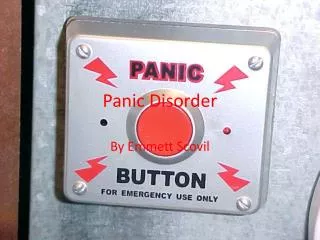
Panic Disorder Analyzing Attacks of Extreme Anxiety Doug Kirchner AP Psychology, Upper St. Clair H.S.
Student Objectives: • Define panic disorder, and identify its symptoms, prevalence, and causes. 2. Describe and locate the help available to those who suffer from panic disorder. 3. Explain what “I” can do to help.
Warm-up: Silently read the following statements on your handout.
Quick Review of Terms: What are Anxiety Disorders? • A category of psychological disorders • Distressing, persistent anxiety or maladaptive behaviors that reduce anxiety What is the DSM-IV-TR? • Diagnostic and Statistical Manual of Mental Disorders
What is Panic Disorder? An anxiety disorder involving: • Recurrent, unexpected bursts of extreme terror, called panic attacks Followed by at least 1 month of: • unrelenting fear of having another attack, • worry over the attacks’ consequences, or • considerable behavior changes to minimize future attacks.
Who suffers from it? Prevalence: • Approximately 1 in 75 people (roughly 2.4 million Americans) • Typically begins in older adolescence & young adulthood (usually 18 to 24 years old) • 2 out of every 3 sufferers are female
Let’s do some math! USCHS has approximately 1500 students. Q: How many students here could potentially suffer from panic disorder? A: 20 students
How is disorder first identified? • The person experiences repeated, unexpected panic attacks • Defined by the DSM-IV-TR as a “discrete period of intense fear or discomfort, in which FOUR (or more) of the following symptoms developed abruptly and reached a peak within 10 minutes:” • See handout to identify the symptoms
What could happen w/o treatment? • Avoidance behaviors • Agoraphobia • Depression • Drug and/or alcohol abuse • Suicide
What Causes Panic Disorder?
Think-Pair-Share 1 See handout for directions
Biological Factors • Vulnerability to panic disorder tends to run in families. • Twin studies: Higher concordance rates among identical twins
Biological Factors • Possible imbalance of neurotransmitters involved in arousal • Serotonin & Norepinephrine Smokers have a fourfold risk of a 1st-time panic attack. Why?
Environmental Factors • Major life transitions • Stimulus generalization • 1st attack occurs in one location • Fear another attack in similar locations
Environmental Factors • Learned helplessness increases fear • Maintained by negative reinforcement • Excessive focus on potential threats (Cognitive)
Bio-Psycho-Social Factors Increased vulnerability/biological imbalances Major life transition/stress Panic Attack Subsequent fear of/focus on future attacks
Think-Pair-Share 2 How do you think the problem affects school life?
How might the problem affect school life? • Test/performance anxiety • Poor academic performance • Avoidance of school entirely
Legal safeguards in PA Students with panic disorder are protected by a: Section 504 Service Agreement • Not an “Individualized Education Program” (IEP) • Right to receive specific aids, services, or accommodations
What WE can do to help Brainstorm a list of possibilities with your partner. Some suggestions: • Talk with them about possible triggers. • Stand near them in stressful situations (e.g. speeches)
The link below will provide parents with info about Panic Disorder Your Child and Panic Disorder
What professional help is available?(See assignment) • Cognitive Therapy • Behavior Therapy • Medication Only 1 in 4 people with Panic Disorder actually get treatment!
Local Assistance Mental Health Association of Allegheny County: • A consumer advocacy group dedicated to individuals who suffer from mental disorders • See your attached brochure for contact info and for the following websites.
Internet Resources • American Psychological Association:http://www.apa.org • Anxiety Disorders Association of America (ADAA): http://www.adaa.org/
Internet Resources 3. Mental Health America: http://www.mentalhealthamerica.net • MentalHelp.net:http://www.mentalhelp.net/ • National Institute of Mental Health (NIMH):http://www.nimh.nih.gov/
Current Books • Facing Panic: Self-Help for People with Panic Attacksby R. Reid Wilson, PhD • How to Help Your Loved One Recover from Agoraphobia by Karen P. Williams • Shared Confinement: Healing Options for You and the Agoraphobic in Your Life by Robert C. Chope, PhD
Did You Know? • Charles Darwin began suffering from Panic Disorder at age 28 after five years sailing around the world! • He moved to the country, avoided social gatherings, and traveled only with his wife • His seclusion allowed him to focus on developing his theory of evolution
Case Study Assignment Patient Name: Nick Tack Age: 18 Occupation: College student (freshman) Parents: Jen and Nick Sr. (recently divorced) See handout for directions
References Click on the link below for a copy of the presentation’s list of references:
Contact Info Copyright 2007, Doug Kirchner. Please contact the author at dkirchner@uscsd.k12.pa.us or dek24@pitt.edu if you wish to duplicate this material.