CK12 Flexbooks on Factoring Polynomial
20 likes | 21 Vues
"CK12 Flexbooks on Factoring Polynomial explains Factoring polynomials uses the same concept of factoring integers - we look for simpler monomials or binomials whose product is equal to the binomial/trinomial we’re factoring. Some techniques used in factoring polynomials include looking for common factors and using special factoring patterns. "


CK12 Flexbooks on Factoring Polynomial
E N D
Presentation Transcript
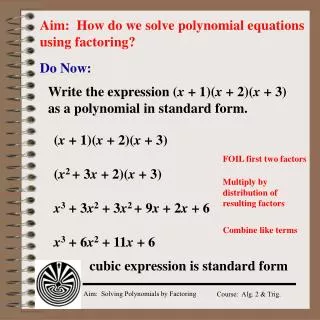
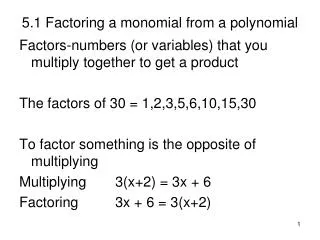
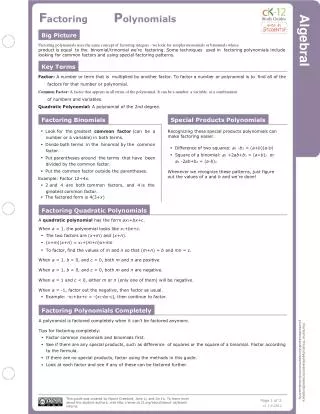
Factoring Polynomials AlgebraI Study Guides Big Picture Factoring polynomials uses the same concept of factoring integers - we look for simpler monomials or binomials whose product is equal to the binomial/trinomial we’re factoring. Some techniques used in factoring polynomials include looking for common factors and using special factoring patterns. Key Terms Factor: A number or term that is multiplied by another factor. To factor a number or polynomial is to find all of the factors for that number or polynomial. Common Factor: A factor that appears in all terms of the polynomial. It can be a number, a variable, or a combination of numbers and variables. Quadratic Polynomial: A polynomial of the 2nd degree. Factoring Binomials Special Products Polynomials • Look for the greatest common factor (can be a Recognizing these special products polynomials can make factoring easier. number or a variable) in both terms. • Divide both terms in the binomial by the common • Difference of two squares: a2 -b2 = (a+b)(a-b) factor. • Square of a binomial: a2 +2ab+b2 = (a+b)2 or • Put parentheses around the terms that have been a2 -2ab+b2 = (a-b)2 divided by the common factor. • Put the common factor outside the parentheses. Whenever we recognize these patterns, just figure out the values of a and b and we’re done! Example: Factor 12+4x. • 2 and 4 are both common factors, and 4 is the greatest common factor. • The factored form is 4(3+x) Factoring Quadratic Polynomials A quadratic polynomial has the form ax2+bx+c. When a = 1, the polynomial looks like x2+bx+c. • The two factors are (x+m) and (x+n). • (x+m)(x+n) = x2+(m+n)x+mn • To factor, find the values of m and n so that (m+n) = b and mn = c. When a = 1, b > 0, and c > 0, both m and n are positive. When a = 1, b < 0, and c > 0, both m and n are negative. When a = 1 and c < 0, either m or n (only one of them) will be negative. When a = -1, factor out the negative, then factor as usual. • Example: -x2+bx+c = -(x2-bx-c), then continue to factor. Factoring Polynomials Completely A polynomial is factored completely when it can't be factored anymore. yourtextbookandisforclassroomorindividualuseonly. Disclaimer:thisstudyguidewasnotcreatedtoreplace Tips for factoring completely: • Factor common monomials and binomials first. • See if there are any special products, such as difference of squares or the square of a binomial. Factor according to the formula. • If there are no special products, factor using the methods in this guide. • Look at each factor and see if any of these can be factored further. This guide was created by Nicole Crawford, Jane Li, and Jin Yu. To learn more Page 1 of 2 about the student authors, visit http://www.ck12.org/about/about-us/team/ v1.1.9.2012 interns.
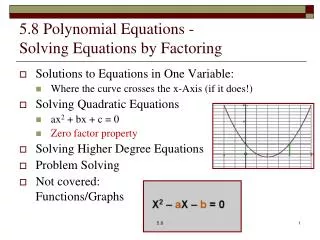
Factoring Polynomials cont. Algebra Factoring Polynomials Completely (cont.) Factoring by Groups If there are four or more terms, sometimes we can only factor a common monomial from some of the terms. Go ahead and factor the common monomials from groups of terms, then see if there is a common binomial factor. Example: Factor 2x+2y+ax+ay. 1. There is no monomial common to all the terms, but there is an x common to one pair of terms and a y common to another pair. Factor them out: x(2+a) + y(2+a) 2. There is a (2+a) common to both terms, so factor it out: (x+y)(2+a) This can be used to solve quadratic expressions ax2+bx+c where a ≠ 1. 1. Find the product ac. 2. Look for two numbers that multiply to ac and add up to b. 3. Rewrite the bx term into two terms using the numbers we found in step 2. 4. Factor the expression by grouping. Example: Factor 3x2+8x+4. 1. ac = 12 2. 2 ∙ 6 = 12 and 2+6 = 8 3. Rewrite 8x as 2x + 6x: 3x2+2x+6x+4. 4. Factor by grouping: x(3x+2) + 2(3x+2) (3x+2)(x+2) It might be helpful to make an organized list when looking for two numbers that multiply to ac and add up to b. For the problem above, the list might look like this: Factors of 12 Sum of Factors Sum Equal 8? 1 ∙ 12 1+12 = 13 No 2 ∙ 6 2+6 = 8 Yes 3 ∙ 4 3+4 = 7 No Solving Problems by Factoring Zero-Product Property: If two numbers multiply to zero, then at least one of those numbers must be zero. If a ∙ b = 0, then a = 0 or b = 0 (or both a and b equal 0). Factoring can be used to solve polynomial equations. 1. If necessary, rewrite the equation in standard form so that the right side equals zero. 2. Factor the polynomial completely. 3. Use the zero-product property to set each factor equal to zero. 4. Solve each equation. Example: Solve x2+7x = -6. 1. Rewrite the equation so that the right side equals zero: x2+7x+6 = 0. 2. Factor completely: (x+6)(x+1) = 0 3. Use the zero-product property: (x+6) = 0 or (x+1) = 0 4. Solve each equation: x = -6 or x = -1 It is very easy to make a sign error. Always check your answers by plugging them back into the equation! Notes Page 2 of 2