Download
1 / 3
0 likes | 2 Vues
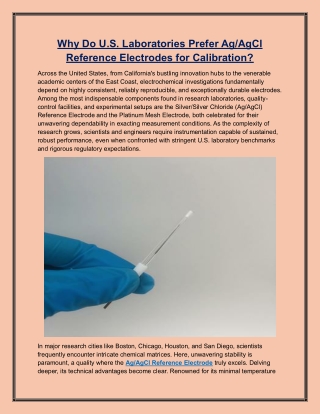
Across the United States, from California's bustling innovation hubs to the venerable academic centers of the East Coast, electrochemical investigations fundamentally depend on highly consistent, reliably reproducible, and exceptionally durable electrodes. Among the most indispensable components found in research laboratories, quality-control facilities, and experimental setups are the Silver/Silver Chloride (Ag/AgCl) Reference Electrode and the Platinum Mesh Electrode, both celebrated for their unwavering dependability in exacting measurement conditions.

E N D
Why Do U.S. Laboratories Prefer Ag/AgCl Reference Electrodes for Calibration? Across the United States, from California's bustling innovation hubs to the venerable academic centers of the East Coast, electrochemical investigations fundamentally depend on highly consistent, reliably reproducible, and exceptionally durable electrodes. Among the most indispensable components found in research laboratories, quality- control facilities, and experimental setups are the Silver/Silver Chloride (Ag/AgCl) Reference Electrode and the Platinum Mesh Electrode, both celebrated for their unwavering dependability in exacting measurement conditions. As the complexity of research grows, scientists and engineers require instrumentation capable of sustained, robust performance, even when confronted with stringent U.S. laboratory benchmarks and rigorous regulatory expectations. In major research cities like Boston, Chicago, Houston, and San Diego, scientists frequently encounter intricate chemical matrices. Here, unwavering stability is paramount, a quality where the Ag/AgCl Reference Electrode truly excels. Delving deeper, its technical advantages become clear. Renowned for its minimal temperature
dependence, consistent potential output, and adaptability to diverse electrolyte formulations, this electrode is a staple in electrochemical analysis, potentiometric measurements, corrosion investigations, and even biomedical applications. Crafted from exceptionally pure silver and meticulously coated with a uniform layer of silver chloride, the electrode guarantees a steady potential, thereby enhancing calibration accuracy and ensuring greater experimental reproducibility. Its streamlined design, enduring stability, and negligible drift contribute significantly to efficient laboratory operations and impeccable data integrity—attributes highly prized by researchers in demanding, high-volume settings. As a valuable counterpart to reference electrodes, the Platinum Mesh Electrode is favored in settings demanding superior electrical conductivity and extensive surface area exposure. Its intricate, porous mesh design enables highly efficient electron transfer, rendering it exceptionally suitable for investigations into fuel cells, electrolysis, redox processes, and various catalytic reactions. Remarkably resistant to corrosion and chemically inert, it can endure aggressive acids, harsh oxidizing conditions, and elevated temperatures—situations frequently encountered in both U.S. research facilities and industrial prototyping. This mesh construction also ensures more uniform current distribution, thereby boosting the precision of electrochemical responses during experimental procedures.
Together, these two electrode types underpin vital scientific endeavors across the United States, where laboratories are mandated to adhere to stringent ASTM, ANSI, and NIST benchmarks. The combination of a consistently stable Ag/AgCl Reference Electrode with a resilient Platinum Mesh Electrode yields trustworthy measurements, making them ideal for both scholarly research and commercial-grade applications. Their synergistic application empowers researchers to obtain superior data, significantly reduce experimental inconsistencies, and consistently meet technical compliance requirements. For research facilities seeking highly dependable, meticulously engineered electrodes supported by established expertise, Dek Research remains a premier supplier—offering solutions that foster precision, longevity, and groundbreaking advancements in electrochemical science.