
virtue theory
E N D
Presentation Transcript
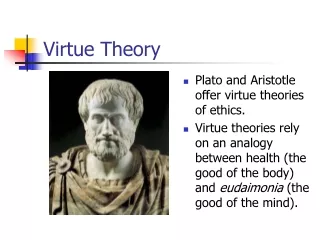
Virtue Theory • Plato and Aristotle offer virtue theories of ethics. • Virtue theories rely on an analogy between health (the good of the body) and eudaimonia (the good of the mind).
The Good Life • Virtue theory is concerned with identifying and cultivating character traits that enable individuals to flourish as members of a community. • It begins by identifying an end (human flourishing) and proceeds by seeking to discover the means (understood as human character traits) that are required to realize that end.
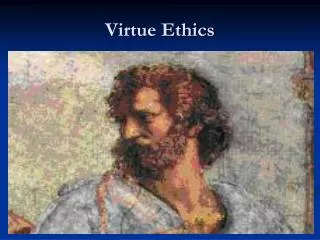
Aristotle on Human Excellence • A virtue (arete, excellence) is a character trait, acquired by practice, that disposes a person to adopt the right course of action in morally charged situations. Virtues are life-skills that enable a person to realize their potential for living the good life as a rational, social, animal.
Good= the aim, end, or goal (telos) of an activity. What is the goal (final end) of living a human life? All agree: Happiness (eudaimonia, well-being, flourishing). What is happiness? Pleasure? No, too Brutish. Wealth? No, it’s a means, not a final end. Honor? No, it’s not self-sufficient. Virtue? No, it’s not complete. The end sought must be final, self-sufficient, and complete. Are we not more likely to hit the mark if we have a target?
What is the function of human life? • To find the human good, find the human function (ergon, what a thing does that makes it what it is). What is the characteristically human activity? Nutrition and growth? (No, all living things); Sensation? (No, all animals); Rational activity. Function of a good human: rational activity in accordance with virtue. [Objectors ask: Are evil people irrational?]
As a skill or craft, virtue is acquired by practice. Patterns of behavior produce states of character. Good character produces good behavior. If you imitate good people, you’ll become one. Moral virtues control natural feelings (passions, appetites) and actions, making them arise in the right amounts at the right times for the right reasons (such a rule or principle as would arise in the mind of the practically wise person). Becoming Excellent
Virtue: a mean between extremes • Confidence, appetites, anger, giving $. • Excess Mean Deficiency • Foolhardiness Courage Cowardice • Indulgence Temperance Insensibility • Hot head Cool head Apathetic • Too generous Generous Stingy
Heroic: extraordinary goodness. Virtuous: Takes pleasure in doing good. Continent: Must control bodily desires in order to do good. Incontinent: Try's, but fails, to control bodily desires, and so does evil. Vicious: Takes pleasure in doing evil. Bestial: Subhumanly wicked. Character Types
McGinn on Virtue • The big four: kindness, honesty, justice, independence. • Kindness: generous feelings towards others, concern for their welfare. • Honesty: letting your real beliefs and opinions be known; a powerful commitment to the truth. • Justice: Detached respect for moral truth.
Independence • The capacity to make up your own mind based on the relevant evidence and facts. A commitment to base beliefs on an unbiased review of evidence. • It is important to be able to read and write. It is also important to have some mathematical proficiency. But more important than either of these is the ability to arrive at informed and thoughtful moral judgments. (Colin McGinn)