Download
1 / 3
0 likes | 2 Vues
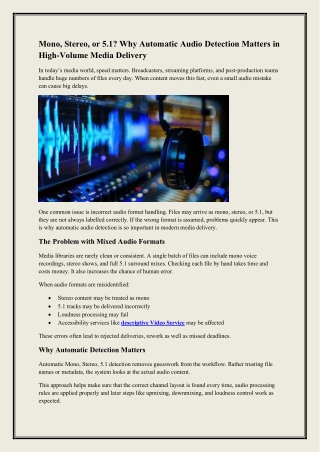
In todayu2019s media world, speed matters. Broadcasters, streaming platforms, and post-production teams handle huge numbers of files every day. When content moves this fast, even a small audio mistake can cause big delays.

E N D
Mono, Stereo, or 5.1? Why Automatic Audio Detection Matters in High-Volume Media Delivery In today’s media world, speed matters. Broadcasters, streaming platforms, and post-production teams handle huge numbers of files every day. When content moves this fast, even a small audio mistake can cause big delays. One common issue is incorrect audio format handling. Files may arrive as mono, stereo, or 5.1, but they are not always labelled correctly. If the wrong format is assumed, problems quickly appear. This is why automatic audio detection is so important in modern media delivery. The Problem with Mixed Audio Formats Media libraries are rarely clean or consistent. A single batch of files can include mono voice recordings, stereo shows, and full 5.1 surround mixes. Checking each file by hand takes time and costs money. It also increases the chance of human error. When audio formats are misidentified: •Stereo content may be treated as mono •5.1 tracks may be delivered incorrectly •Loudness processing may fail •Accessibility services like descriptive Video Service may be affected These errors often lead to rejected deliveries, rework as well as missed deadlines. Why Automatic Detection Matters Automatic Mono, Stereo, 5.1 detection removes guesswork from the workflow. Rather trusting file names or metadata, the system looks at the actual audio content. This approach helps make sure that the correct channel layout is found every time, audio processing rules are applied properly and later steps like upmixing, downmixing, and loudness control work as expected.
For teams handling large volumes of content, automation is no longer a nice extra. It is essential for scaling without losing quality. How Emotion Systems Helps Emotion Systems’ Engine is built for automated, file-based audio processing at scale. It is designed to fit into high-volume media workflows where speed and accuracy are critical. Engine can automatically analyze incoming audio and detect whether it is mono, stereo, or 5.1. Once the format is known, the workflow can react in the right way. With Engine, media teams can detect audio channel layouts automatically, apply different processing rules based on the detected format, remap or reorder channels when required, perform upmix or downmix operations within one workflow and more. Because detection happens early, errors are caught before delivery. This saves time and avoids costly fixes later. Supporting Accessibility and Descriptive Video Service Accurate detection is also important for accessibility. Descriptive Video Service tracks rely on correct channel placement so narration is clear and balanced with the main audio. When formats are detected correctly: •Descriptive tracks are kept in the right place •Accessibility compliance is easier to achieve •Viewers get a better experience on any platform Automation helps make sure accessibility is handled the same way every time, even when thousands of files are processed each day. Better Efficiency, Better Results
Manual audio checks do not scale. As content volumes grow, so do the risks. Automatic detection inside Engine allows teams to focus on higher-value work instead of repeating technical checks. The benefits are clear: •Faster turnaround times •Fewer delivery errors •Consistent audio quality •Reliable processing from ingest to delivery In high-volume media delivery, correct audio detection is not just helpful. It is critical.