Populations that stand out from the crowd Tobacco’s disproportionate burden Presenter Name
Populations that stand out from the crowd Tobacco’s disproportionate burden Presenter Name Presenter Agency Date. Your logo here (or delete this box). Key definitions. Health disparities Population-based differences Health inequity Differences caused by systematic and social conditions.

Populations that stand out from the crowd Tobacco’s disproportionate burden Presenter Name
E N D
Presentation Transcript
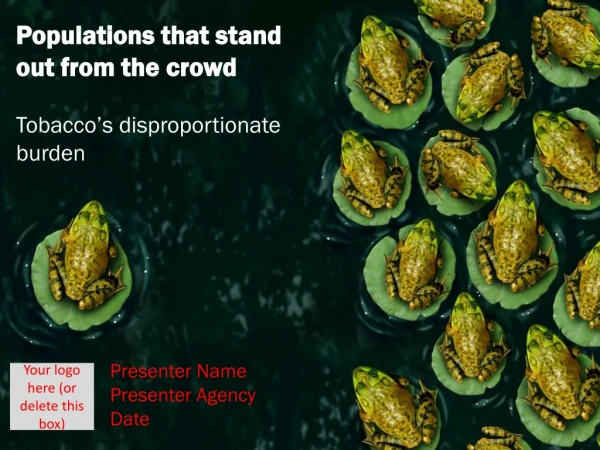
Populations that stand out from the crowd Tobacco’s disproportionate burden Presenter Name Presenter Agency Date Your logo here (or delete this box)
Key definitions • Health disparities • Population-based differences • Health inequity • Differences caused by systematic and social conditions Healthiest People 2020 Assessment Related to Racial Equity2014
70%-80% of homeless adults smoke in the United States Lee TC, Hanlon JG, Ben-David J, et al. Risk factors for cardiovascular disease in homeless adults. Circulation. 2005;111:2629–35
1 out of 3 smokers in the US military started after enlisting 2009 Institute of Medicine
LGB communities smoke more than heterosexual communities High School: YRBS, 2014 Adults: BRFSS, 2015
138,000 respondents (2009-2011 US adults) 20% (n= 27,600) have a mental illness Individuals with a mental illness smoke a third of all cigarettes 33% (n=9,108) adults with a mental illness smoke Centers for Disease Control and Prevention. Vital Signs: Current Cigarette Smoking Among Adults Aged ≥18 Years with Mental Illness—United States, 2009–2011.
77-93%of individuals in treatment for substance abuse addiction smokeThese individuals are more likely to die from their tobacco use than their drug addiction Richter KP, Arnsten JH. A rationale and model for addressing tobacco dependence in substance abuse treatment. Substance Abuse Treatment, Prevention, and Policy. 2006;1:23.
Research shows that when individuals quit tobacco and other substances at the same time, they are 25% more likely to stay off both. Prochaska, JJ et al. A Meta-Analysis of Smoking Cessation Interventions with Individuals in Substance Abuse Treatment or Recovery. Journal of Consulting and Clinical Psychology. 2004;72(6)
Wisconsin pregnant women smoke more than the national average WI US 2011 Pregnancy Risk Assessment and Monitoring System
Racial/ethnic populations are impacted differently 19% WI Average 2011-2015 Wisconsin Behavioral Risk Factor Surveillance System
Nationally, adults with disabilities smoke more than people without disabilities No Disability Disability CDC, MMWR 2014; 63(47):1108-12
Individuals with less education smoke more than other populations 18% WI average 2014 Wisconsin Behavioral Risk Factor Surveillance System
Individuals with lower-incomes smoke at nearly 3x the rate of those with higher-incomes 18% WI average Adults: BRFSS, 2014
Thank you! Tobacco’s disproportionate burden Presenter Name Presenter Agency Date Your logo here (or delete this box)