Download
1 / 6
0 likes | 2 Vues
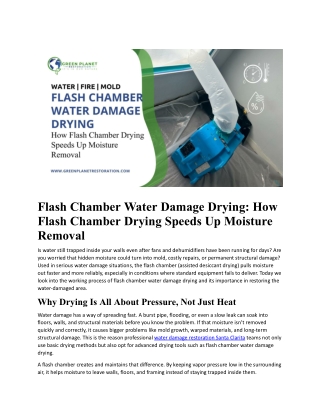
Is water still trapped inside your walls even after fans and dehumidifiers have been running for days? Are you worried that hidden moisture could turn into mold, costly repairs, or permanent structural damage? Used in serious water damage situations, the flash chamber (assisted desiccant drying) pulls moisture out faster and more reliably, especially in conditions where standard equipment fails to deliver. Today we look into the working process of flash chamber water damage drying and its importance in restoring the water-damaged area.

E N D
Flash Chamber Water Damage Drying: How Flash Chamber Drying Speeds Up Moisture Removal Is water still trapped inside your walls even after fans and dehumidifiers have been running for days? Are you worried that hidden moisture could turn into mold, costly repairs, or permanent structural damage? Used in serious water damage situations, the flash chamber (assisted desiccant drying) pulls moisture out faster and more reliably, especially in conditions where standard equipment fails to deliver. Today we look into the working process of flash chamber water damage drying and its importance in restoring the water-damaged area. Why Drying Is All About Pressure, Not Just Heat Water damage has a way of spreading fast. A burst pipe, flooding, or even a slow leak can soak into floors, walls, and structural materials before you know the problem. If that moisture isn’t removed quickly and correctly, it causes bigger problems like mold growth, warped materials, and long-term structural damage. This is the reason professional water damage restoration Santa Clarita teams not only use basic drying methods but also opt for advanced drying tools such as flash chamber water damage drying. A flash chamber creates and maintains that difference. By keeping vapor pressure low in the surrounding air, it helps moisture to leave walls, floors, and framing instead of staying trapped inside them.
What a Flash Chamber Actually Does Wet building materials hold a lot of moisture, which means they have higher vapor pressure. Dry air has lower vapor pressure. When there’s a clear and greater difference between the two, moisture moves out of materials more quickly. A flash chamber is part of a desiccant dehumidification system. Desiccant systems work differently from standard low grain refrigerant dehumidifiers. Instead of cooling air to remove moisture, they use a drying material, called a desiccant, that actively absorbs moisture from the air. As the desiccant wheel does its job, it eventually becomes full of moisture. To keep the system working, that moisture has to be removed. At this stage a flash chamber is brought into action. How Flash Chamber Water Damage Drying Speeds Up the Process
When the desiccant material is regenerated, heat is applied to release the moisture it’s holding. This creates hot, humid air. That air is then directed into the flash chamber, where several important things happen very quickly. 1. Rapid Pressure Drop Inside the flash chamber, the system creates a controlled drop in pressure. When that hot, moisture-heavy air hits lower pressure, the water vapor expands and cools almost instantly. This makes it much easier to separate moisture from the air. 2. Easier Moisture Removal Because of the sudden change in temperature and pressure, moisture becomes easier to extract. Some of it condenses, and some is mechanically separated and vented out of the system. 3. Faster, More Efficient Drying By removing large amounts of moisture quickly, the flash chamber allows the desiccant system to keep running at peak performance. That means drier air is constantly being pushed back into the affected space, pulling even more moisture out of building materials. The end result is faster, deeper, and more controlled Flash Chamber Water Damage Drying. Why Flash Chambers Matter in Santa Clarita Water Damage Restoration Jobs
Traditional refrigerant dehumidifiers work best in warm, humid conditions. In cooler climates like Santa Clarita or in unheated buildings, basements, or large commercial spaces, they can slow down or lose effectiveness. Flash chamber - supported desiccant systems don’t have that limitation. They perform well in: ● Cold or unconditioned buildings ● Large commercial and industrial spaces ● Occupied properties that need controlled drying ● Thick or dense materials like concrete, insulation, hardwood, and subfloors This makes Flash Chamber Water Damage Drying useful for complex water damage projects where consistency and speed matter. Faster Drying Means Less Damage
One of the greatest benefits of flash chamber drying is how much time it saves. Shorter Recovery Time By rapidly lowering vapor pressure and keeping the desiccant system running efficiently, drying times can be reduced from weeks to just days, or even less in some cases. That means less disruption and a quicker return to normal. Lower Risk of Mold and Secondary Damage The moisture existence in a structure, increases the risk of mold growth, material breakdown and odors. Flash chamber drying removes moisture before those problems have time to develop, helping protect both the property and the people inside it. Don’t Let Hidden Moisture Turn Into Major Damage
Flash chamber water damage drying is used when serious moisture is involved. It is one of the most effective tools available. It allows restoration professionals to dry structures faster, more evenly, and in conditions where standard methods just don’t cut it. Green Planet Restoration Santa Clarita uses advanced drying methods like flash chamber systems to remove moisture fast and stop any more risks. Property affected by recent water damage? Act now! Contact us at (661) 464-1251 today to get professional, precise water damage restoration done right the first time.