QCF presentation
Presentation by David Tournay on the QCF system and its application in the heritage sector


QCF presentation
E N D
Presentation Transcript
QCF(Qualifications Credit Framework)Its application in the heritage sector David Tournay 24th March 2011 Evolution Partnership Skills Project Management & Design
Aims: • Introduce you to some of the basic concepts of the QCF • Set out how it compares with other qualification frameworks • Provide an example of how a heritage organisation might take advantage
Proof of academic capability License to practice Role of qualifications Indicator of our vocational capability Proof of past performance
Functions of QCF: Sets a comparable series of levels Series of design rules and tools
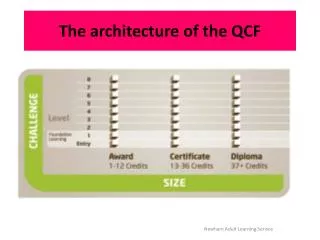
QCF Levels Level Challenge Foundation Learning Tier Size
Higher Education Framework Level 8 Doctorates Level 7 Masters Degrees Level 6 BA/BSC PGCE Graduate Diplomas Level 5 Foundation Degree Diploma in Higher Education HND HNC Certificate in Education Level 4
Relationship between QCF and HE Frameworks: • Not a compulsory framework – institutions do not have to follow it • Based on an agreed set of common principles for design – modular structure, broad learning outcomes • Institutions regulate themselves
Graduate model: Level 3 Unit: Surveying Go on to study another academic qualification and/or further higher level QCF units, or professional qualification Level 2 Unit: Operating Machinery BSc Degree: Environmental Conservation Level 3 Unit: Planting technology Individual units or adding up to a larger qualification
The PST Model Marine Engineering Apprenticeship Level 2 QCF Dip Marine Engineering Higher level apprenticeship or professional qualification e.g. CTQ Or Foundation Degree Level 2 QCF Dip Marine Technical Certificate Level 2 QCF unit: Caulking Level 2 QCF unit: Timber selection Literacy & Numeracy certificates BSc Degree: Environmental Conservation Employment Rights and Responsibilities Developed by ourselves and/or with Awarding Organisation
Routes for QCF unit development: Gain recognition as ‘Unit Submitting Body’ Develop relationship with awarding body to develop units and submit them for approval Develop units and gain approval for them Work with Awarding Organisation to provide quality assurance and implement administration of qualification/units
Conclusions: • QCF is no easy fix – but I think it is worth it • Opportunity to highlight the unique skills that make our sector so special • Opportunity to ‘join up’ many of the range of disparate qualifications that are available
Thank you Evolution Partnership Skills project management and design Tel. 07809 395187 davidt@evolution-partnership.com www.pioneersailingtrust.org.uk