CNC Prototype vs 3D Printed Prototype: When to Choose Which Method?
Compare CNC machining and 3D printing for speed, cost, and accuracy. HLH Prototypes helps you choose the right method for your prototype to go from concept to production fast.

CNC Prototype vs 3D Printed Prototype: When to Choose Which Method?
E N D
Presentation Transcript
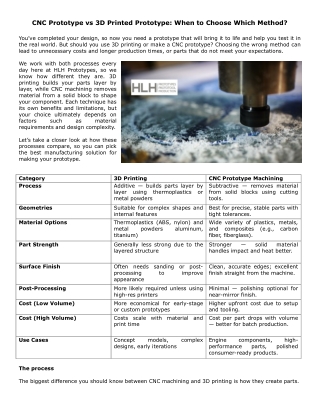
CNC Prototype vs 3D Printed Prototype: When to Choose Which Method? You’ve completed your design, so now you need a prototype that will bring it to life and help you test it in the real world. But should you use 3D printing or make a CNC prototype? Choosing the wrong method can lead to unnecessary costs and longer production times, or parts that do not meet your expectations. We work with both processes every day here at HLH Prototypes, so we know how different they are. 3D printing builds your parts layer by layer, while CNC machining removes material from a solid block to shape your component. Each technique has its own benefits and limitations, but your choice ultimately depends on factors such as material requirements and design complexity. Let’s take a closer look at how these processes compare, so you can pick the best manufacturing solution for making your prototype. Category 3D Printing Process Additive — builds parts layer by layer using thermoplastics or metal powders CNC Prototype Machining Subtractive — removes material from solid blocks using cutting tools. Geometries Suitable for complex shapes and internal features Thermoplastics (ABS, nylon) and metal powders titanium) Best for precise, stable parts with tight tolerances. Wide variety of plastics, metals, and composites (e.g., carbon fiber, fiberglass). Material Options aluminum, Part Strength Generally less strong due to the layered structure Stronger handles impact and heat better. — solid material Surface Finish Often needs sanding or post- processing appearance Clean, accurate edges; excellent finish straight from the machine. to improve Post-Processing More likely required unless using high-res printers More economical for early-stage or custom prototypes Costs scale with material and print time Minimal — polishing optional for near-mirror finish. Higher upfront cost due to setup and tooling. Cost per part drops with volume — better for batch production. Cost (Low Volume) Cost (High Volume) Use Cases Concept designs, early iterations models, complex Engine performance consumer-ready products. components, parts, high- polished The process The biggest difference you should know between CNC machining and 3D printing is how they create parts.
3D printing builds your parts one layer at a time with an additive approach using materials such as thermoplastics or metal powders. This makes it suitable for complex geometries and internal features. On the other hand, CNC machining uses a subtractive method, starting with a block of material and then removing layers using precision cutting tools. This produces a highly accurate and stable CNC prototype, but generates more waste than additive manufacturing. Because CNC machines rely on rigid tooling and multi-axis movements, they deliver tight tolerances and repeatable results. Part strength and durability ACNC prototype is usually the better option if your design requires maximum strength. Since machined parts come from solid material, they naturally handle impact and heat more effectively. This makes CNC machining a strong choice when you’re making engine components and products for high-performance applications. Material compatibility 3D printing materials commonly include thermoplastics like ABS and nylon for general prototyping, and metal powders like aluminum and titanium for DMLS. Meanwhile, you can build a CNC prototype from an extensive list of metals and plastics, including composites like fiberglass and carbon fiber. Because CNC machining works with solid stock materials, it gives you more options for projects that require specific mechanical or thermal properties. Surface finishing Cutting tools are more effective at creating clean, accurate edges, so your CNC prototype will usually have an excellent surface finish. Post-processing is hardly required, but you can request polishing to achieve a near-mirror sheen. This makes CNC machining a strong choice for applications where appearance or smooth surfaces matter, such as consumer products and medical components. On the other hand, you will usually need additional finishing, such as sanding, to improve the look and texture of 3D-printed parts. That said, you can work with manufacturers with newer high-resolution printers to produce much smoother results straight off the machine, reducing the amount of finishing required. Cost 3D printing is often more economical when you’re making early prototypes. You won’t have to worry about tooling fees, and the cost will depend on the material consumption and print time. So, it can be cost- effective when you need a custom prototype or quick concept model. Although a CNC prototype might cost more upfront, the price significantly decreases when you need more parts. The cost per unit decreases with volume, so you can save money when producing durable, repeatable parts in larger batches. That said, keep in mind that factors such as labor and machining time can influence overall pricing. We can help you choose Still not sure what to choose? Request a free project review here at HLH Prototypes and let our team help you out. We’ll analyze your requirements and recommend the most suitable manufacturing solution that fits your needs.