Biotic controls on microbial communities in estuarine and riverine habitats
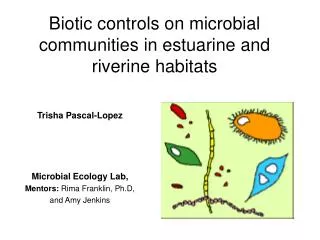
Biotic controls on microbial communities in estuarine and riverine habitats . Trisha Pascal-Lopez Microbial Ecology Lab, Mentors: Rima Franklin, Ph.D, and Amy Jenkins. Nutrient Input (ex. farm runoff) Algal Bloom (consumed by bacteria) Bacteria (hypoxia) Marine creature die

Biotic controls on microbial communities in estuarine and riverine habitats
E N D
Presentation Transcript
Biotic controls on microbial communities in estuarine and riverine habitats Trisha Pascal-Lopez Microbial Ecology Lab, Mentors: Rima Franklin, Ph.D, and Amy Jenkins
Nutrient Input (ex. farm runoff) • Algal Bloom (consumed by bacteria) • Bacteria (hypoxia) • Marine creature die • Trophic cascade
A. Purpose • Study the ecological relationships that occur in an aquatic microbial food web • To understand the interdependence of three levels of the food web (phytoplankton, bacteria, and grazers) • Focus on response of bacteria to other community members www.jerrygreerphotography.com/james_river_summer_reflection.htm
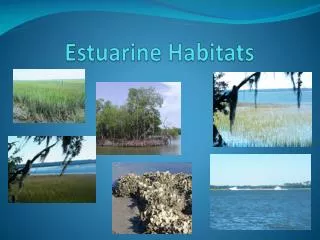
B. Setup 1) Two different initial environment samples: • James River mile 21 (Estuarine) • James River Rice Center (Riverine) Courtesy of Paul Bukaveckas & River Ecology lab
B. Setup 2) Four treatments: • Manipulated light and dark levels • Eukaryotic growth inhibitor (cycloheximide) • 3 replicate of each treatment per environment, 3 day incubation
Methods 1) Phytoplankton community: • Fluorescence detection of chlorophyll levels 2) Bacterial community: • Abundance (microscopic direct counts) • Culturability (counts of solid media/agar) • Genetic profiling (RAPD DNA fingerprints) 3) Grazer community: • Abundance and diversity (microscopic determination) • Mainly protozoa, rotifers and larvae www.compucyte.com/pubbacterialdetection.htm
C. Results Estuary site Initial comparison • Distinct communities at start of experiment • Estuary had lower phytoplankton, grazer and bacteria abundance than riverine site (Rice). Rice Center
Were the treatments effective? • Changes to the phytoplankton population (greater for estuary) • Affected estuary & riverine phytoplankton differently • Reduced grazer abundance • Grazers linked to phytoplankton? • Decrease in grazer diversity
How did bacteria respond to the changes in the phytoplankton and grazer abundance/ diversity? Estuary: Bacteria abundance not linked to phytoplankton or grazers abundances (unaffected in all treatments). Rice Center (Riverine): Treatments had an effect on bacterial community.
Light + cyclohex. Dark + cyclohex. Light Dark Light + cyclohex. Dark + cyclohex. Light Dark Changes in bacterial community composition? Estuary: Community composition similar in all treatments River: Changes in bacterial community with each treatment.
Implications • Microbial communities in the Estuarine and Riverine environments are different. • Estuarine environment bacterial communities are not linked to grazer or phytoplankton abundance • Riverine environment shows bacterial interactions with phytoplankton and grazer communities • Microbial community interactions vary depending on the environment which controls their response to environmental stress.
D. Future Goals • Statistical analysis of data • Chemistry (Nitrogen and DOC) • Run the experiment again with changes • Add another mile marker • Collect water sample at different seasons or times of day • Manipulate nutrient concentration
Questions? Thank You