
SlideServe
Menu
Préférences
© SlideServe · v2026

Timothy E. Fulbright

Kelvin_Ajay avatar
28 diapositives · 564 Views · Mar 30, 2011

But does with fawns on Welder selected brush-dominated areas and ... Telemetry work with fawns selection of non-native vs. native patches; survival of fawns bedding in non ...
Timothy E. Fulbright - slide 1
01 / 28Timothy E. Fulbright
1 / 17

Télécharger la présentation

Timothy E. Fulbright
Une image / un lien ci-dessous est fourni (tel quel) pour télécharger la présentation

Politique de téléchargement : le contenu du site vous est fourni TEL QUEL pour votre information et votre usage personnel ; il ne peut être vendu, concédé sous licence ni partagé sur d’autres sites sans l’accord de son auteur.Le contenu vous est fourni TEL QUEL, pour votre information et votre usage personnel uniquement. Téléchargez la présentation en cliquant sur ce lien. Lors du téléchargement, si vous ne parvenez pas à télécharger une présentation, l’éditeur a peut-être supprimé le fichier de son serveur.Pendant le téléchargement, si vous ne parvenez pas à obtenir une présentation, le fichier a peut-être été supprimé par l’éditeur.

F I N

Plus de contenu associé

Transcription de la présentation
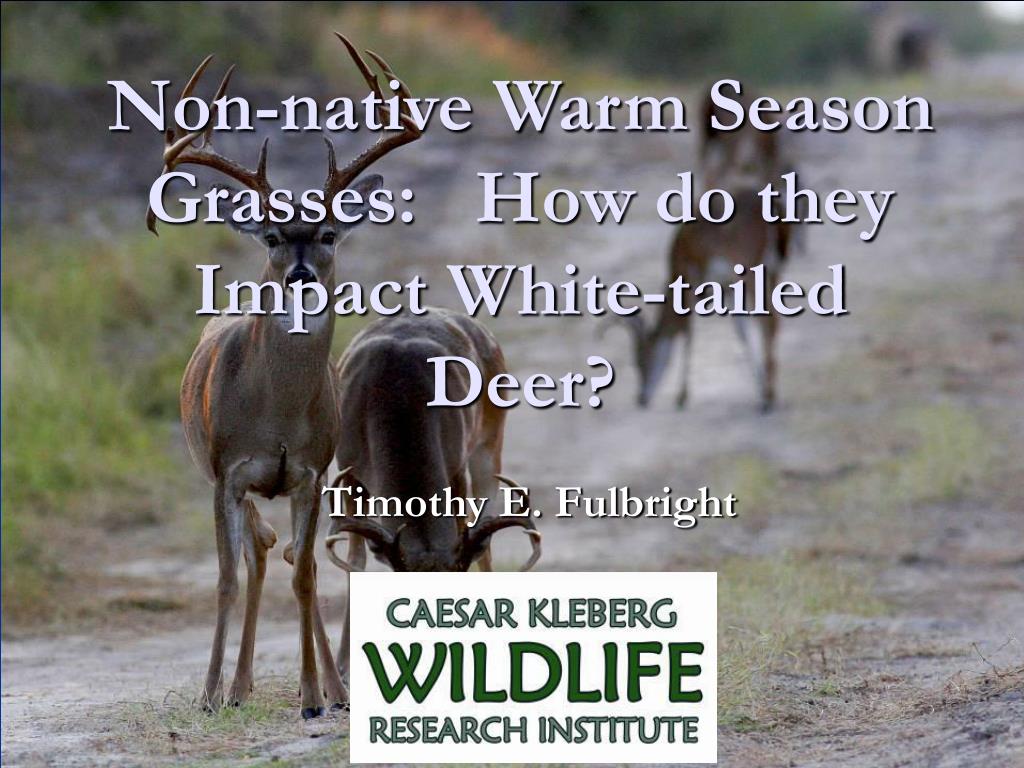
  1. Non-native Warm Season Grasses: How do they Impact White-tailed Deer? Timothy E. Fulbright

  2. Synopsis • Non-native grasses continue to spread via invasion and intentional propagation • No scientific documentation of effects on deer productivity • We only have hypotheses • Potential exists for negative impacts • Research needed

  3. Outline • What are non-native grasses? • Spread of non-native grasses • Rate of spread • Reasons for spread • Potential impacts on deer habitat • Forage • Fawn cover • Change in fire regimes

  4. What Are Non-native Grasses? • Grasses that did not evolve in North America • Buffelgrass • Bermudagrass • Old world bluestems (Kleberg, KR, Silky, Angleton) • Lehmann lovegrass • Blue panicum • Johnsongrass • Kleingrass • Lovegrasses (Lehmann, Wilman, Weeping) • Rhodesgrass

  5. Spread of Non-native Grasses • We don’t know how fast they are spreading or how many new acres planted each year • Buffelgrass predicted to cover 12% of Mexico

  6. Why are Non-native Grasses Increasing • Intentional planting • CRP • Rangeland seeding • Disturbance • Climate change?

  7. Why are Non-native Grasses Increasing • Intentional planting • CRP • Rangeland seeding • Disturbance • Climate change?

  8. Buffelgrass canopy cover P = 0.02

  9. Does fire facilitate exotic grass invasion?

  10. Disturbance • Lehmann lovegrass increases following fire and drought • Re-establishes more successfully than natives because of • Abundant seed • Germination strategies Angell and McClaran. 2001. J. Arid Environ. 49:507-520.

  11. Why are Non-native Grasses Increasing • Intentional planting • CRP • Rangeland seeding • Disturbance • Climate change? • Freezing temps • Summer rainfall

  12. Guineagrass • Killed by temperatures < 20 C

  13. Non-native Grasses & Deer • Forage? • Fawn cover? • Fire regimes?

  14. Seed Company in South TexasActual wording from website • “Buffel grass is an excellent source of feed for white tail deer and other wildlife” • “Buffel grass also provides great cover for the does to hide their fawns”  • “The fact that deer will graze on Buffel grass allows game managers to control the habitat conditions for the deer”

  15. M. W. Meyer, R. D. Brown and M. W. Graham. Protein and Energy Content of White-Tailed Deer Diets in the Texas Coastal Bend. Journal of Wildlife Management 48:527-534.

  16. Forage • Deer prefer forbs • Negative relationship between canopy cover of exotic grasses and forbs

  17. Guineagrass cover vs. forb cover

  18. Forb cover negatively related to Lehmann Lovegrass cover in Arizona • Williams and Baruch. 2000. Biological Invasions 2:123-140.

  19. Fawn Cover • Why do you have more fawns when you have more grass? Hypotheses - - • Hiding cover? • But does with fawns on Welder selected brush-dominated areas and avoided grasslands • Nutrition? • Reduced grazing = more forbs • More grass = more buffer species?

  20. Fawn Cover • Guthery, F. S., T. E. Anderson, and V. W. Lehmann. 1979. Range rehabilitation enhances cotton rats in south Texas. J. Range Manage. 32:354-356. • Cotton rat densities 4 times greater in rangeland dominated by buffelgrass & KR bluestem than in native rangeland

  21. Fire Regimes • Reduced regeneration of browse plants?

  22. Conclusions • Increase in non-native grasses may reduce forbs & woody cover • Deer are highly adaptable and are very plastic in food habits • invasion of non-native grasses may have little impact • impact may be difficult to detect, particularly in the short term

  23. The Future • Global warming & shift to summer rainfall may favor subtropical grasses such as buffelgrass, Natal grass, Guineagrass, Lehmann lovegrass

  24. Research Needs • Habitat use – do deer avoid areas dominated by non-native grasses? • GPS collars – habitat selection/avoidance • Foraging studies with tame deer – do they avoid patches of non-native grasses? • Telemetry work with fawns – selection of non-native vs. native patches; survival of fawns bedding in non-natives versus exotics • Carrying capacity studies with confined deer