Quick-Release Pins
Quick-Release Pins are mechanical fasteners designed for fast and easy assembly and removal of parts without using tools. They are widely used in applications where components need to be frequently adjusted, removed, or replaced.<br><br>These pins provide secure locking with simple push-button or pull-ring operation.

Quick-Release Pins
E N D
Presentation Transcript
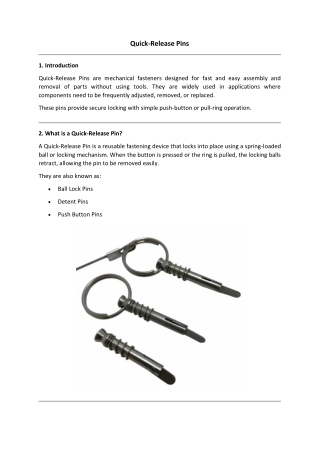
Quick-Release Pins 1. Introduction Quick-Release Pins are mechanical fasteners designed for fast and easy assembly and removal of parts without using tools. They are widely used in applications where components need to be frequently adjusted, removed, or replaced. These pins provide secure locking with simple push-button or pull-ring operation. 2. What is a Quick-Release Pin? A Quick-Release Pin is a reusable fastening device that locks into place using a spring-loaded ball or locking mechanism. When the button is pressed or the ring is pulled, the locking balls retract, allowing the pin to be removed easily. They are also known as: •Ball Lock Pins •Detent Pins •Push Button Pins
3. Construction and Design A typical quick-release pin consists of: •Handle (Button or Ring) •Pin Shaft (Body) •Locking Balls (usually 2 or more) •Internal Spring Mechanism •Retaining Button or Grip The locking balls expand when the button is released, securing the pin inside the hole. 4. Types of Quick-Release Pins 1) Push Button Quick-Release Pins •Operated by pressing a button •Most common type •Provides secure locking 2) Ring Grip Quick-Release Pins •Operated by pulling a ring •Simple and cost-effective •Suitable for light to medium loads 3) T-Handle Quick-Release Pins •T-shaped handle for easy grip •Used in heavy-duty applications 4) L-Handle Quick-Release Pins •L-shaped handle •Good for quick manual operation 5) Double-Acting Pins •Require button to be pressed during insertion and removal •Extra safety
5. Materials Used Quick-release pins are manufactured from: •Stainless Steel (SS 304, SS 316) •Alloy Steel •Carbon Steel •Aluminum (for lightweight use) Material selection depends on load capacity and environmental conditions. 6. Surface Finishes Common finishes include: •Passivation (for stainless steel) •Zinc Plating •Black Oxide •Anodizing (for aluminum) These finishes improve corrosion resistance and durability. 7. Sizes and Dimensions Available in: •Diameter: Typically from 4 mm to 25 mm (or custom sizes) •Grip Length: Customizable •Overall Length: Based on application •Metric and Inch sizes Grip length is the usable length of the pin between the head and locking balls. 8. Working Principle 1.Press the button or pull the ring. 2.Locking balls retract into the shaft. 3.Insert the pin into aligned holes. 4.Release the button.
5.Balls expand and lock the pin in place. The pin stays secured until the button is pressed again. 9. Applications Quick-release pins are used in: •Automotive assemblies •Aerospace equipment •Agricultural machinery •Construction equipment •Fitness equipment •Marine applications •Medical equipment •Industrial tools •Trailers and towing systems They are ideal where fast assembly and disassembly is required. 10. Advantages •Tool-free operation •Fast installation and removal •Reusable •Strong locking mechanism •Corrosion resistant (stainless steel) •Available in custom sizes •Reduces maintenance time 11. Limitations •Higher cost than standard pins •Not suitable for extremely high permanent loads •Must be properly maintained to ensure smooth operation
12. Load Capacity Load capacity depends on: •Pin diameter •Material strength •Design type •Application conditions Manufacturers provide shear strength and tensile strength ratings. 13. Installation Guidelines •Ensure holes are properly aligned •Use correct diameter pin •Keep locking mechanism clean •Avoid forcing the pin •Regularly inspect for wear For More Details https://www.rajgranthfasteners.com/quick-release-pins-manufacturers-suppliers-exporters- stockists.html Contact US: +91-7977945282 If any enquiries please contact us our support team will connect you as soon as possible