How to Design a Hack-Proof Website
As we all know how valuable a website is to the success of today business. But when a website isn’t secure, it becomes a hard risk. And when a website gets hacked, it becomes a hard expense, possibly destroying a business. So this brings us to our first step to creating a website that can’t be hacked.

How to Design a Hack-Proof Website
E N D
Presentation Transcript
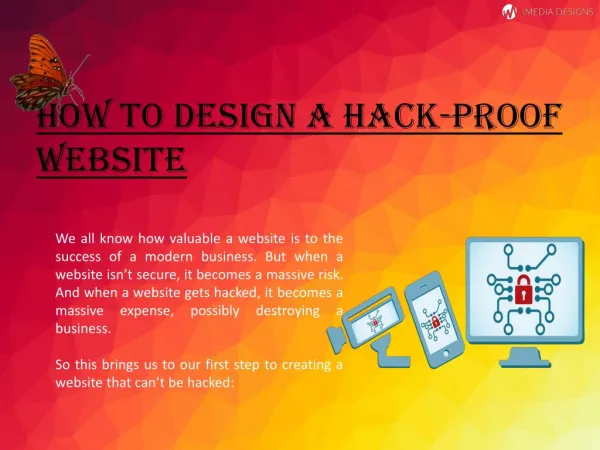
How to Design a Hack-Proof Website We all know how valuable a website is to the success of a modern business. But when a website isn’t secure, it becomes a massive risk. And when a website gets hacked, it becomes a massive expense, possibly destroying a business. So this brings us to our first step to creating a website that can’t be hacked:
Step 1: Keep Up to Date You need to keep your website as up to date as possible. It seems like a no brainer, but this is by far one of the most common problems for hacked websites. As stated earlier, hackers are constantly evolving – so you need to as well. If your business is operating on a custom web design platform, ask your development partner about an Annual Maintenance Contract, or some sort of deal for updating to the latest and greatest when it’s needed
Step 2: Security Applications Other web for improved security are out there and many are free. Just as a quick note, we don’t recommend solely relying on free tools. Some tools come loaded with a CMS Platform (like a Magento or Joomla). Magento web design can help you to analyze your website for weaknesses. Don’t be afraid to use this – both before launch and as an ongoing security measure
Step 3: Web Application Firewalls A web application firewalls(WAF) isn’t in the news as much as something like a Man-in-the- Middle or a Phishing attack, but is possible one of the best security tools for the price point. A WAF, widely available as an extension or plugin all over the web and most have a pretty fair price based on a subscription. A WAF sits between the wide world of the internet and your website. It intercepts and reads ALL data that is transmitted to your website.
Step 4: Limit Internal Access Another very common way to get hacked is by not being careful about admin or user access to website. This can be easily rectified in a variety of ways. Also, all passwords should be immediately encrypted and stored with some sort of hashing.
Thank YOU ! For More Info Visit Us at- https://www.imediadesigns.ca/ Call Us at- +1 (800-780-0392) Office Address- 481 University Street, suite 703, Toronto Ontario M5G 2E9 CANADA