Machine Learning Models: Intelligent Systems with Data and Algorithms
The intelligent digital systems are based on Machine Learning Models. Organizations can create high-performing, reliable and scalable AI solutions using Machine Learning, advanced Object Detection, powerful Deep Learning and accurate Data Annotation. All these components together make it possible to make smarter decisions, automate, and become innovative in all sorts of applications.

Machine Learning Models: Intelligent Systems with Data and Algorithms
E N D
Presentation Transcript
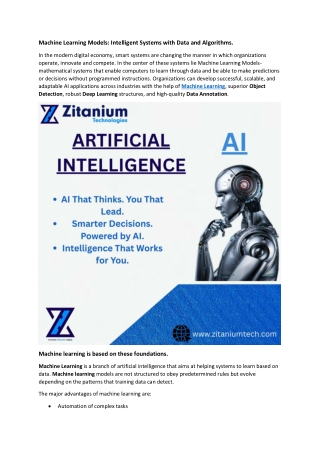
Machine Learning Models: Intelligent Systems with Data and Algorithms. In the modern digital economy, smart systems are changing the manner in which organizations operate, innovate and compete. In the center of these systems lie Machine Learning Models- mathematical systems that enable computers to learn through data and be able to make predictions or decisions without programmed instructions. Organizations can develop successful, scalable, and adaptable AI applications across industries with the help of Machine Learning, superior Object Detection, robust Deep Learning structures, and high-quality Data Annotation. Machine learning is based on these foundations. Machine Learning is a branch of artificial intelligence that aims at helping systems to learn based on data. Machine learning models are not structured to obey predetermined rules but evolve depending on the patterns that training data can detect. The major advantages of machine learning are: •Automation of complex tasks
•Improved accuracy over time •Big data scalability. •Live and foresight knowledge. The concept of machine learning is the basis of sophisticated AI applications that include recommendation engines, fraud detection, and predictive analytics. Object Detection Visual Intelligence. Object Detection is a niche application of machine learning that involves the given objects recognition and search in photographs or video frames. It does not just classify the object but also ascertains its whereabouts and what the object is. Applications in common object detection are: •Video surveillance and security. •Autonomous vehicles •Industrial inspection •Retail analytics Object-detection machine learning models allow systems to comprehend real time visual scenes. Deep Learning of Powering Intelligence. Deep Learning is also a sophisticated form of machine learning that provides the ability to process multi-layered neural networks with complex data (images, video, speech, and text). Deep learning models are effective in the tasks where accuracy and contextual comprehension are required. The main features of deep learning models are: •Capability to handle unstructured data. •Automatic feature selection. •Image and speech recognition High performance. •Large data scaling. State-of-the-art computer vision systems and object detection are both based on deep learning. The Data Annotation: A Critical Role. To train successful machine learning models, it is necessary to have a high-quality Data Annotation. Annotation is the process of marking raw data, i.e., pictures, video, and text, in a way that models can learn it. Examples of data annotation are: •Bounding box Object detector images. •Semantic segmentation •Text labeling and tagging •Audio transcription Correct annotation has direct effects on model performance, reliability and generalization. Conclusion:
The intelligent digital systems are based on Machine Learning Models. Organizations can create high-performing, reliable and scalable AI solutions using Machine Learning, advanced Object Detection, powerful Deep Learning and accurate Data Annotation. All these components together make it possible to make smarter decisions, automate, and become innovative in all sorts of applications. FAQs What do machine learning models represent? They are data adaptive algorithms that learn by data to make decisions or predictions. What is the importance of data annotation? It gives labeled information that assists models in learning properly. What is the difference between deep learning and machine learning? Multi-layer neural networks are applied in the tasks of deep learning. What is the purpose of using object detection? It recognizes and finds objects in the pictures or video. Is there a way that machine learning can be improved with time? Yes, they get better with increased and better training. For more information contact us on: Zitanium Technologies sales@zitaniumtech.com +91 93465 03546 H. №2–4–68/26, Plot no. 26, Sogbowli Village, Attapur, Rajendra Nagar, India — 500048 Or click on the below link for more information: https://zitaniumtech.com/service/artificial-intelligence/ Deep Learning Machine Learning Object Detection Data Annotation