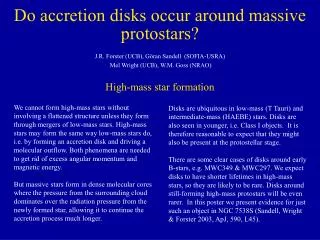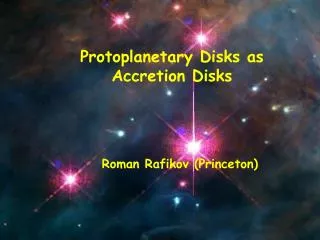
Resolved Inner Disks around Herbig Ae/Be Stars: Near-IR Interferometry with PTI
160 likes | 551 Vues
Resolved Inner Disks around Herbig Ae/Be Stars: Near-IR Interferometry with PTI. Josh Eisner Collaborators: Ben Lane, Lynne Hillenbrand, Rachel Akeson, and Anneila Sargent. Eisner et al. 2003, ApJ, 598, 1341 Eisner et al. 2004, ApJ, submitted. Ringberg Castle, 2004. Circumstellar Disks.


Resolved Inner Disks around Herbig Ae/Be Stars: Near-IR Interferometry with PTI
E N D
Presentation Transcript
Resolved Inner Disks around Herbig Ae/Be Stars: Near-IR Interferometry with PTI Josh Eisner Collaborators: Ben Lane, Lynne Hillenbrand, Rachel Akeson, and Anneila Sargent • Eisner et al. 2003, ApJ, 598, 1341 • Eisner et al. 2004, ApJ, submitted Ringberg Castle, 2004
Circumstellar Disks • Disks linked to star and planet-formation • Accretion mechanism: IMF, stellar rotation, magnetic properties, outflows • Disk properties (e.g., temperature, density, geometry) dictate planetary properties • Relation to proto-solar nebula Artist’s conception of TW Hya Disk
Herbig Ae/Be stars: • Higher-mass analog of T Tauris: 2-10 M • Emission lines,variability, excess IR and mm emission • SED models: thin accretion disks (Hillenbrand et al. 1992), flared disks (Chiang & Goldreich 1997), puffed up inner disk walls (Dullemond et al. 2001) • Forbidden emission lines (Corcoran & Ray 1997) • Ha spectropolarimetry (Vink et al. 2002) • Resolved mm emission: flattened structures on 100 AU scales with Keplerian rotation • Strong evidence from new near-IR interferometry • Herbig Ae/Be stars: • Higher-mass analog of T Tauris: 2-10 M • Emission lines,variability, excess IR and mm emission • SED models: thin accretion disks (Hillenbrand et al. 1992), flared disks (Chiang & Goldreich 1997), puffed up inner disk walls (Dullemond et al. 2001) • Forbidden emission lines (Corcoran & Ray 1997) • Ha spectropolarimetry (Vink et al. 2002) • Resolved mm emission: flattened structures on 100 AU scales with Keplerian rotation • Strong evidence from new near-IR interferometry • Herbig Ae/Be stars: • Higher-mass analog of T Tauris: 2-10 M • Emission lines,variability, excess IR and mm emission • SED models: thin accretion disks (Hillenbrand et al. 1992), flared disks (Chiang & Goldreich 1997), puffed up inner disk walls (Dullemond et al. 2001) • Forbidden emission lines (Corcoran & Ray 1997) • Ha spectropolarimetry (Vink et al. 2002) • Resolved mm emission: flattened structures on 100 AU scales with Keplerian rotation • Strong evidence from new near-IR interferometry • Herbig Ae/Be stars: • Higher-mass analog of T Tauris: 2-10 M • Emission lines,variability, excess IR and mm emission • SED models: thin accretion disks (Hillenbrand et al. 1992), flared disks (Chiang & Goldreich 1997), puffed up inner disk walls (Dullemond et al. 2001) • Forbidden emission lines (Corcoran & Ray 1997) • Ha spectropolarimetry (Vink et al. 2002) • Resolved mm emission: flattened structures on 100 AU scales with Keplerian rotation • Strong evidence from new near-IR interferometry • Herbig Ae/Be stars: • Higher-mass analog of T Tauris: 2-10 M • Emission lines,variability, excess IR and mm emission • SED models: thin accretion disks (Hillenbrand et al. 1992), flared disks (Chiang & Goldreich 1997), puffed up inner disk walls (Dullemond et al. 2001) • Forbidden emission lines (Corcoran & Ray 1997) • Ha spectropolarimetry (Vink et al. 2002) • Resolved mm emission: flattened structures on 100 AU scales with Keplerian rotation • Strong evidence from new near-IR interferometry … < 0.1-1 AU (Dullemond, Dominik, & Natta 2001) (Vink et al. 2002) (Corcoran & Ray 1997) (Mannings & Sargent 1997) Disks Around HAEBEs • Herbig Ae/Be stars: • Higher-mass analog of T Tauris: 2-10 M • Emission lines,variability, excess IR and mm emission • SED models: thin accretion disks (Hillenbrand et al. 1992), flared disks (Chiang & Goldreich 1997), puffed up inner disk walls (Dullemond et al. 2001) • Forbidden emission lines (Corcoran & Ray 1997) • Ha spectropolarimetry (Vink et al. 2002) • Resolved mm emission: flattened structures on 100 AU scales with Keplerian rotation • Strong evidence from new near-IR interferometry
Ds amplitude delay Palomar Testbed Interferometer (PTI) • PTI observations allow large sample, good uv coverage • longer baselines facilitate detection of asymmetry • PTI components: • 3 telescopes each 0.4 m • 110 m NS oriented 20º E of N (4 mas) • 85 m NW oriented 81º E of N (5 mas) • 87 m SW baseline recently operational! • two apertures (A1,A2), delay lines (DL), beam combiner (BC), single-mode fiber (SMF), detector s DL A2 BC A1 SMF Detector DL B
System visibility from unresolved calibrators Ds amplitude delay Fringe Measurement: V2 Sky U-V • I1 ~ e-ik d1 e-iwt ; I2 ~ e-k d2 e-iks•B e-iwt;IC = I1 + I2 • P = <IC*IC> = 2+2cos(k [s•B+d1-d2]) • Fringe Spacing: Ds = l/B (~5 mas for PTI) • Visibilities: V(u,v) = ∫ dx dy A(x,y) F(x,y) e-2pi(ux+vy) • u = Bx/l ; v = By/l • V is the FT of brightness distribution (van Cittert-Zernike theorem) • IFT: F(x,y) A(x,y) = ∫ du dv V(u,v) e2pi(ux+vy) • PTI measures normalized V2
PTI Observations of HAEBEs • 2.2 mm observations of 14 HAEBEs SpTyp ~ O9-F0; d~100-1000 pc • Fit models to PTI visibilities: uniform disk, Gaussian, ring, accretion disk with hole, flared disk with puffed-up inner wall (+star) • All but 2 sources (HD141569, HD158352) resolved; angular sizes ~1-6 mas. • Inclinations: • MWC 480, MWC 758, CQ Tau, VV Ser, V1685Cyg, AS 442, MWC 1080 inclined • AB Aur nearly face-on • V1295 Aql, T Ori, MWC 297 unknown • Puffed-up inner disk inconsistent for earliest spectral types: MWC 297, V1685 Cyg, MWC 1080 uv sky
PTI+IOTA Data • Some of our sample also observed by IOTA (Millan-Gabet, Schloerb, & Traub 2001) • K-band: AB Aur, MWC 1080 • H-band: AB Aur, T Ori, MWC 297, V1295 Aql, V1686 Cyg, MWC 1080 • Shorter baselines than PTI (20-40m vs. 85-110m)additional constraints on geometry • Larger FOV than PTI (3˝ vs 1˝) constrains incoherent emission from extended dust
SEDs • Inner radius, inclination from PTI data; provide inputs for SED modeling. Can probe large range of disk radii, constrain parameters including temperature, overall geometry, mass) • SEDs compiled from new JHK PALAO data and the literature (stellar params from published spec type & BVRI photometry) • 2 models: • geometrically thin accretion disks w/ inner holes • flared 2-layer disks w/ puffed-up inner walls Trim, Tint, Tsurf Parameters: Rin, i, Tin,Rout,b, S, kn T(R) R-3/4 Parameters: Rin,i, Tin (Rout)
Flared Passive Disks with Puffed-Up Inner Walls Geometrically Flat Accretion Disks
Inner Disk Vertical Structure • For later-type HAEBEs, puffed-up inner disk models better • Early-types are fit well by flat disk models; not at all by puffed-up inner walls • Different accretion mechanism? Puffed-Up Inner Disks Flat Inner Disks
Inner vs. Outer Disks: Warping? PTI near-IR: i ≈ 10-20 Millimeter: i ≈ 76 Mannings & Sargent 1997
Summary • PTI observations of 14 HAEBEs: 12 resolved (1-6 mas), ≥7 significantly inclined • No significant mis-alignment of inner and outer disks • Different vertical disk structure for early and late spectral types • Flat accretion disks better for early-types • Flared disks w/ puffed-up inner walls for later types • Magnetospheric accretion in HAes vs. Equatorial accretion in HBes?