Layer 2 Blockchain- Explained
Ethereum Blockchain platform, the most widely used and most secure, is not without problems despite being the most popular. There are 13 transactions per second on the Ethereum Mainnet, and the gas prices are expensive. Continue Reading....<br><br>To know more , visit : https://www.blockchain-council.org/blockchain/top-10-blockchain-platforms-you-need-to-know-about/

Layer 2 Blockchain- Explained
E N D
Presentation Transcript
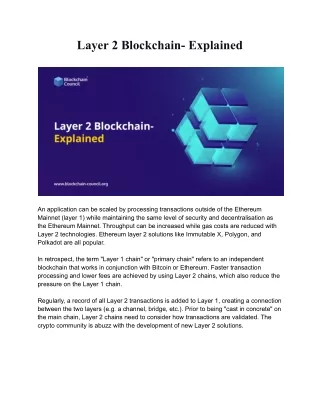
Layer 2 Blockchain- Explained An application can be scaled by processing transactions outside of the Ethereum Mainnet (layer 1) while maintaining the same level of security and decentralisation as the Ethereum Mainnet. Throughput can be increased while gas costs are reduced with Layer 2 technologies. Ethereum layer 2 solutions like Immutable X, Polygon, and Polkadot are all popular. In retrospect, the term "Layer 1 chain" or "primary chain" refers to an independent blockchain that works in conjunction with Bitcoin or Ethereum. Faster transaction processing and lower fees are achieved by using Layer 2 chains, which also reduce the pressure on the Layer 1 chain. Regularly, a record of all Layer 2 transactions is added to Layer 1, creating a connection between the two layers (e.g. a channel, bridge, etc.). Prior to being "cast in concrete" on the main chain, Layer 2 chains need to consider how transactions are validated. The crypto community is abuzz with the development of new Layer 2 solutions.
Layer 2: What is it? Many well-known weaknesses have been discovered in Ethereum's unique financial structure. Ethereum can currently process around 15 transactions per second in its present configuration. A number of challenges have arisen because of this, such as a regularly congested network and skyrocketing petrol prices. It is desirable to have a decentralised, scalable, and secure blockchain. By adding more powerful nodes, it is possible to speed up transactions; but, it comes at a price. Decentralisation Because of the anticipated increase in scalability with Ethereum 2.0, the update will take some time to finish. With daily transactions reaching 1 million, Ethereum urgently needs an alternative option. This is the responsibility of layer 2. The scalability layer is built on top of the foundation chain. Layer 1 protocols, such as Ethereum and Bitcoin, are what they're called. All transactions are settled through this layer of the network. While the main chain remains secure, layer 2 solutions enable for higher transaction speeds and scaling. If Ethereum is to win mainstream popularity, it will need to be able to process thousands of transactions per second. What Are The Advantages Of Using Layer 2 Solutions Over Layer 1 Solutions? As the Ethereum blockchain becomes increasingly decentralised, transparent, and secure, Layer 2 solutions will become increasingly significant as a means of decreasing carbon emissions while improving scalability and performance (less gas, means less energy used, which equates to less carbon.)
Ethereum Blockchain platform, the most widely used and most secure, is not without problems despite being the most popular. There are 13 transactions per second on the Ethereum Mainnet, and the gas prices are expensive. Layer 2s sit on top of the Ethereum blockchain and ensure that all transactions are safe, quick, and scalable. It is important to keep in mind that each system has its own set of advantages and disadvantages. These include throughput, gas costs; security; scalability; and, most importantly, usefulness. There isn't a layer 2 solution that can meet all of these requirements just yet, however. Rollup scaling, on the other hand, aims to improve all of these characteristics. Bringing Things To A Close A major shift in the blockchain ecosystem could be made by Ethereum layer 2 solutions. In order to maintain the Ethereum Mainnet's high level of security while also allowing for quick and cheap transactions, Layer 2 solutions are needed. To get more people to try out the Ethereum blockchain and all of its advantages, this type of technology is needed. Remember that many layer 2 solutions are still in beta, so do your homework and experiment with different layer 2 solutions with caution. It's time to get started on your journey to become a blockchain expert by signing up for the Blockchain Developer course.

![Rescattering explained….. [2]](https://cdn3.slideserve.com/5398438/slide1-dt.jpg)