Fiber Laser Welding Machine_ Working Principle
0 likes | 2 Vues
A Fiber Laser welding Machine uses a high-intensity laser beam generated through optical fiber technology to join metal parts with strong and clean welds. The laser beam focuses on a small area, creating deep penetration and minimal heat spread, which results in smooth joints and less distortion. This method is widely used in automotive, electrical, fabrication, and metal industries for stainless steel, aluminum, and other alloys.


Fiber Laser Welding Machine_ Working Principle
E N D
Presentation Transcript
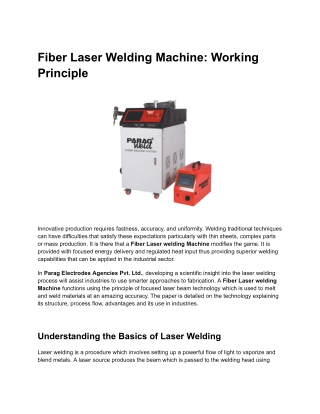
Fiber Laser Welding Machine: Working Principle Innovative production requires fastness, accuracy, and uniformity. Welding traditional techniques can have difficulties that satisfy these expectations particularly with thin sheets, complex parts or mass production. It is there that a Fiber Laser welding Machine modifies the game. It is provided with focused energy delivery and regulated heat input thus providing superior welding capabilities that can be applied in the industrial sector. In Parag Electrodes Agencies Pvt. Ltd., developing a scientific insight into the laser welding process will assist industries to use smarter approaches to fabrication. A Fiber Laser welding Machine functions using the principle of focused laser beam technology which is used to melt and weld materials at an amazing accuracy. The paper is detailed on the technology explaining its structure, process flow, advantages and its use in industries. Understanding the Basics of Laser Welding Laser welding is a procedure which involves setting up a powerful flow of light to vaporize and blend metals. A laser source produces the beam which is passed to the welding head using
fiber optics. As opposed to the traditional arc welding, which involves the use of electrical arcs, a Fiber Laser welding Machine makes use of condensed light energy. Fiber is used in reference to fiber optic cable which transmits the laser beam effectively with little loss of energy. This design gives the flexibility of machine layout and better stability of the beam. One of the reputed Fiber Laser welding Machine Manufacturers specializes in providing consistent quality of beams, maximum power output and fine control systems that would ensure uniform welding results. Core Components of a Fiber Laser Welding Machine In order to gain some insight into the working principle, it is important to provide a comprehension of the key elements within a Fiber Laser welding Machine. The core of the system is the laser source. It produces the laser light by stimulated emission of radiation within a fiber optic material. This energy is passed to the welding head by the beam delivery system. The beam is focused on the surface of the working piece by the focusing lens. The power settings, pulse frequency and welding parameters are controlled with the use of the control panel. As an organization that is a Fiber Laser welding Machine supplier, it has taken the lead as a Manufacturer with some of the best optical components and stable power modules to demonstrate the kind of quality that a good Fiber Laser welding machine is supposed to have. Working Principle Explained Step by Step The operation principle of a Fiber Laser welding Machine starts with the connection to electricity energy. This power is excited in the working fiber material within the laser source. Upon the stimulus, the medium releases photons which amplify to a coherent laser beam. The beam is made to pass through fiber optic cables and to the welding head. A focusing lens helps to focus the beam into a small and high energy spot on the metal surface. This high intensity of heat at this focal point causes the material to melt immediately. The process may be run in conduction mode or keyhole mode depending on the application. During conduction mode, the surface liquefies and a smooth weld pool is created. Deeper penetration is also realized in keyhole mode because the vaporized metal forms a small cavity to amplify the absorption of energy. These parameters are programmed to the level of accuracy by a professional Fiber Laser welding Machine Manufacturer to match different industrial materials.
Heat Control and Precision One of the biggest advantages of a Fiber Laser welding Machine is controlled heat input. Traditional welding spreads heat across a broader area, increasing distortion. Laser welding concentrates heat in a narrow zone, reducing thermal impact. This controlled energy delivery allows manufacturers to weld thin sheets without warping. Stainless steel, carbon steel, aluminum, and other alloys respond well to this process. Parag Electrodes Agencies Pvt. Ltd. emphasizes heat management technology to provide machines capable of consistent welding performance in industrial conditions. Beam Quality and Stability Beam quality defines weld accuracy. A high-quality beam produces smooth, uniform joints with minimal spatter. The optical system inside a Fiber Laser welding Machine maintains beam focus and alignment. Stable power output prevents inconsistencies during operation. This stability is one of the reasons industries prefer machines from a trusted Fiber Laser welding Machine Manufacturer. Automation and Integration Modern fabrication facilities integrate laser welding with automation systems. A Fiber Laser welding Machine can connect with CNC systems, robotic arms, or conveyor-based production lines. Automation improves repeatability. It reduces human error and enhances productivity. Industrial units benefit from faster welding cycles and consistent joint quality. Parag Electrodes Agencies Pvt. Ltd. supports industries seeking advanced automation-ready welding systems. Applications Across Industries The versatility of a Fiber Laser welding Machine allows usage across automotive, electronics, medical equipment, aerospace, and sheet metal fabrication sectors.
In automotive manufacturing, laser welding supports lightweight vehicle construction. In electronics, it joins delicate components without damaging surrounding parts. A reputed Fiber Laser welding Machine Manufacturer designs equipment capable of handling varied thickness ranges and material types. Advantages Over Conventional Welding Laser welding offers deeper penetration, minimal distortion, high-speed operation, and reduced post-processing. The weld seam is clean and aesthetically precise. Because the process requires less filler material, operational efficiency improves. The focused beam reduces spatter and rework time. Parag Electrodes Agencies Pvt. Ltd. recognizes these advantages and provides solutions that meet evolving manufacturing expectations. Safety Considerations Laser systems require safety enclosures and protective eyewear. A well-designed Fiber Laser welding Machine includes interlock systems and emergency stop mechanisms. Industrial safety standards must be followed during installation and operation. Reliable equipment from an experienced Fiber Laser welding Machine Manufacturer incorporates protective measures aligned with industry norms. Maintenance and Longevity Maintenance of a Fiber Laser welding Machine primarily involves cleaning optical components and checking cooling systems. Compared to traditional welding machines, fiber laser systems have fewer consumable parts. With proper maintenance, these machines deliver long service life and consistent output. Parag Electrodes Agencies Pvt. Ltd. provides technical guidance to support smooth machine operation over time. Energy Efficiency and Operational Cost Laser welding is energy-efficient due to concentrated beam delivery. Reduced heat spread lowers power consumption compared to some traditional methods.
Operational cost savings also arise from reduced rework and minimal material waste. Selecting the right Fiber Laser welding Machine Manufacturer helps industries balance performance and cost efficiency effectively. Why Choose Us Parag Electrodes Agencies Pvt. Ltd. brings technical expertise and industrial experience to every welding solution delivered. As a dependable Fiber Laser welding Machine Manufacturer partner, the company focuses on performance stability, advanced optical systems, and application-specific recommendations. Each Fiber Laser welding Machine is selected with attention to material compatibility, production speed, and operational reliability. Instead of generic equipment supply, Parag Electrodes Agencies Pvt. Ltd. prioritizes structured technical guidance and long-term client support for industries seeking modern welding technology. Conclusion The working principle of a Fiber Laser welding Machine is based on concentrated light energy that melts and fuses materials with exceptional precision. By transmitting laser beams through fiber optics and focusing them onto targeted areas, this technology achieves deep penetration and minimal distortion. Industries benefit from improved speed, accuracy, and efficiency. Choosing a reliable Fiber Laser welding Machine Manufacturer plays a vital role in obtaining consistent performance and long-term operational stability. With proper integration, maintenance, and application planning, fiber laser welding systems support advanced manufacturing demands across multiple industrial sectors. For expert insights on Fiber Laser Welding Machine: Working Principle and advanced welding solutions, contact Parag Electrodes Agencies Pvt. Ltd. at +91 9099014043 or email info@paragweld.com today.
FAQs 1. What is the main advantage of a Fiber Laser welding Machine? It provides high precision, deep penetration, and minimal heat distortion compared to conventional welding methods. 2. How does a Fiber Laser welding Machine generate heat? It converts electrical energy into a concentrated laser beam that melts metal at the focal point. 3. Is fiber laser welding suitable for thin materials? Yes, it offers controlled heat input, making it ideal for thin sheets and delicate components. 4. What industries use Fiber Laser welding Machine technology? Automotive, aerospace, electronics, medical equipment, and sheet metal fabrication industries commonly use it. 5. How important is choosing the right Fiber Laser welding Machine Manufacturer? Selecting a reliable manufacturer supports stable performance, technical support, and long-term operational efficiency.