HAZWOPER General Site Workers
HAZWOPER General Site Workers. Personnel responsible for safety/health. Personnel and alternates responsible for safety and health May vary according to job responsibilities. 1a. Safety and health hazards. Potential exposures to chemical hazards Biological and radiological hazards

HAZWOPER General Site Workers
E N D
Presentation Transcript
Personnel responsible for safety/health • Personnel and alternates responsible for safety and health • May vary according to job responsibilities 1a
Safety and health hazards • Potential exposures to chemical hazards • Biological and radiological hazards • Principles of toxicology • General safety hazards 2a
Personal protective equipment • Equipment selection and use • Maintenance and storage • Decontamination and disposal • Training and proper fit 3a
Personal protective equipment • Donning and doffing procedures • Inspection • In-use monitoring • Program evaluation 3b
Personal protective equipment • Equipment limitations • Employers must provide and require the use of PPE where engineering controls are not feasible 3c
Personal protective equipment • PPE must be appropriate to the: • requirements/limitations of the site • task-specific conditions and duration • identified hazards and potential hazards 3d
Work practices to minimize risk from hazards • Examples of safe work practices include removing all non-essential personnel from potential exposure while: • opening drums • wetting down dusty operations • placing employees upwind of potential hazards 4a
Work practices to minimize risk from hazards • The standard covers two specific work practices: • Handling and Labeling Drums and Containers 1910.120(j) • Sanitation of Temporary Workplaces 1910.120(n) 4b
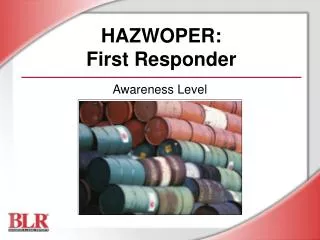
Work practices to minimize risk from hazards Handling and labeling drums and containers: • Ensure that drums meet required regulations • Inform employees of appropriate hazard warnings of labeled drums 4c
Work practices to minimize risk from hazards Handling and labeling drums and containers: • Ensure that safe practices are instituted • Standing on or working from drums or containers is prohibited 4d
Work practices to minimize risk from hazards Handling and labeling drums and containers: • Evacuate non-essential employees from the transfer area • Use barriers to protect equipment operators from the transfer area 4e
Work practices to minimize risk from hazards Handling and labeling drums and containers: • Make available a continuous means of communication • Safe removal of bulging drums or containers 4f
Work practices to minimize risk from hazards • Sanitation of temporary workplaces • Privies • Chemical toilets • Recirculation toilets • Combustion toilets 4g
Engineering controls and equipment • Engineering controls and work practices must be implemented to help reduce and maintain employee exposure at or below permissible exposure limits • If engineering and work practice controls are not feasible, use appropriate PPE 5a
Medical surveillance • Medical surveillance helps assess and monitor the health and fitness of employees working with hazardous substances 6a
Medical surveillance Establish a medical surveillance program when: • Employees are exposed to hazardous substances above the PEL for more than 30 days/year 6b
Medical surveillance Establish a medical surveillance program when: • Employees are exposed above the published exposure levels for 30 days or more/year 6c
Medical surveillance Establish a medical surveillance program when: • Workers who wear approved respirators for 30 or more days/year on site 6d
Medical surveillance Establish a medical surveillance program when: • Workers are exposed to unexpected or emergency releases of hazardous wastes above exposure limits 6e
Medical surveillance Establish a medical surveillance program in the following situations: • When employees are members of HAZMAT teams 6f
Medical surveillance • Examinations are performed under the supervision of a licensed physician without cost to the employee, and in a reasonable time and place 6g
Medical surveillance - examinations • Prior to job assignment and annually thereafter • At the termination of employment • Before reassignment to an area where medical examinations are not required 6h
Medical surveillance - examinations • If the examining physician believes that a periodic follow-up is medically necessary • As soon as possible for employees injured or becoming ill from exposure during an emergency 6i
Elements of site-specific safety and health plans • Decontamination procedures • Handling contaminated clothing • Showers and change rooms 7a
Emergency response plans • Review 29 CFR 1910.38 • Review 29 CFR 1910.120(l) 8a
Emergency response plans - required elements • Personnel roles, lines of authority, communications procedures • Pre-emergency planning • Emergency recognition and prevention 8b
Emergency response plans - required elements • Emergency medical and first aid treatment • Methods or procedures for alerting onsite employees • Safe distances and places of refuge 8c
Emergency response plans - required elements • Site security and control • Decontamination procedures • Critique of response and follow-up 8d
Emergency response plans - required elements • PPE and emergency equipment • Evacuation routes/procedures 8e
Confined space entry • Review 29 CFR 1910.146 9a
Spill containment programs • Review 29 CFR 1910.38 10a
Spill containment programs - checklist • Is the plan in writing? • Is the written plan accessible to employees? • Are emergency escape procedures and emergency escape routes assigned? 10b
Spill containment programs - checklist • Are procedures established to account for all employees after the emergency evacuation has been completed? • Has an employee alarm system been developed? 10c
Spill containment programs - checklist • Have enough employees been trained in evacuation? • Has the emergency action plan been reviewed? 10d
Spill containment programs - checklist • Is the written plan kept at the workplace and made available to employees? • Will employees be handling incidental releases? 10e
Spill containment programs • Decontamination equipment • Drop cloths or plastics • Collection containers • Absorbents, foams, chemical containment materials • Long-handled wash brushes, paper cloth towels • Appropriate PPE and books 10f