multi stack motor
A multi-stack stepper motor is a type of variable reluctance stepper motor.<br><br>It is constructed with multiple stator and rotor sections (stacks) along the shaft.<br><br>


multi stack motor
E N D
Presentation Transcript
MULTI-STACK STEPPER MOTOR GROUP 3
WHAT IS A STEPPER MOTOR? A stepper motor is an electromechanical device that converts electrical pulses into discrete mechanical movements. It moves in steps, making it ideal for precise position control.
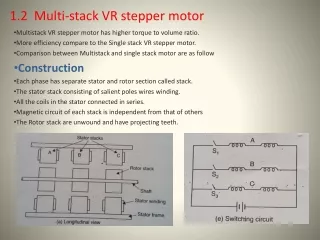
MULTI-STACK STEPPER MOTOR? A multi-stack stepper motor is a type of variable reluctance stepper motor. It is constructed with multiple stator and rotor sections (stacks) along the shaft. Each stack corresponds to a motor phase and is angularly displaced from the others. Key Purpose:To increase the resolution of movement without increasing the number of teeth.
T Stator: Divided into several stacks (usually 2– 5), each with its own winding. Rotor: A common soft iron rotor, also divided into matching stacks. Teeth: Rotor and stator teeth are aligned but shifted between stacks.
WORKING PRINCIPLE How it works: Only one phase (stack) is energized at a time. Rotor aligns with the energized stator teeth due to minimum reluctance. Energizing the next phase shifts the alignment slightly (in small steps). Sequence continues, rotating the rotor in steps. Result: Very fine angular resolution.
ADVANTAGES Printers and plotters CNC machines Automated testing equipment Positioning devices in low-load environments
DISADVATAGES Lower torque than permanent magnet or hybrid types Can be noisy at higher speeds Requires more complex driver circuitry due to multiple stacks
APPLICATIONS Printers and plotters CNC machines Automated testing equipment Positioning devices in low-load environments
SUMMARY A multi-stack stepper motor is ideal for precise, low-torque positioning tasks. It works on variable reluctance and benefits from multi-phase construction. Widely used where accuracy and cost-efficiency are important.