Download
1 / 5
0 likes | 1 Vues
Selecting the right Hydraulic Plastic Baling Machine depends on material type, output capacity, power usage, and daily workload. Industries focus on safe operation, simple maintenance, and long term performance. Power Hydrotech Private Limited offers practical machine options that support waste handling needs while fitting space and budget requirements effectively today.

E N D
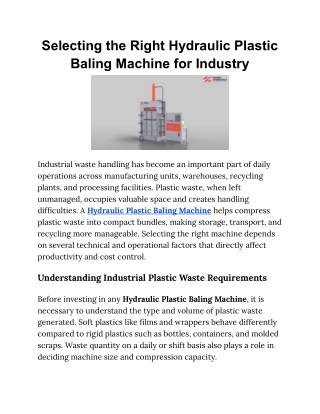
Selecting the Right Hydraulic Plastic Baling Machine for Industry Industrial waste handling has become an important part of daily operations across manufacturing units, warehouses, recycling plants, and processing facilities. Plastic waste, when left unmanaged, occupies valuable space and creates handling difficulties. A Hydraulic Plastic Baling Machine helps compress plastic waste into compact bundles, making storage, transport, and recycling more manageable. Selecting the right machine depends on several technical and operational factors that directly affect productivity and cost control. Understanding Industrial Plastic Waste Requirements Before investing in any Hydraulic Plastic Baling Machine, it is necessary to understand the type and volume of plastic waste generated. Soft plastics like films and wrappers behave differently compared to rigid plastics such as bottles, containers, and molded scraps. Waste quantity on a daily or shift basis also plays a role in deciding machine size and compression capacity.
Common Plastic Materials Handled Industries typically deal with plastic films, PET bottles, HDPE containers, woven sacks, and packaging sheets. Each material requires suitable compression force to form stable bales that hold shape during storage and transport. Bale Size and Handling Needs Bale dimensions influence forklift handling, storage layout, and vehicle loading. Selecting a machine that produces uniform bale sizes helps maintain smooth material movement within the facility. Key Factors to Consider Before Purchase ● Machine Capacity and Output Capacity refers to how much plastic waste the machine can compress within a set time. High waste generating units often need machines with faster cycle times and higher pressure systems. Smaller units may benefit from compact machines with moderate output. ● Hydraulic Pressure and Structure Hydraulic pressure determines compression strength. Machines with well designed frames and balanced pressure distribution produce dense bales that reduce rebound. Structural stability also affects long term machine performance under continuous usage.
● Operation Type and Safety Hydraulic Plastic Baling Machine models are available in manual, semi automatic, and fully automatic variants. Manual systems suit low volume operations, while automated systems support continuous industrial workflows. Safety features such as interlocking doors, emergency stop controls, and guarded hydraulic parts support smooth daily use. Power Consumption and Maintenance Planning Energy usage is an important cost factor in industrial equipment selection. Machines designed for stable power consumption help control operating expenses. Maintenance access should be simple, allowing quick inspection of hydraulic oil levels, seals, and electrical components. ● Hydraulic System Care Regular oil checks and filter cleaning support consistent pressure output. Using quality hydraulic components reduces unexpected downtime and part replacement frequency. ● Long Term Operational Value A well built machine supports extended service life when operated under recommended load conditions. Proper installation and operator training also contribute to steady performance.
Application Based Machine Selection Different industries use Hydraulic Plastic Baling Machine systems for varied purposes. Packaging units focus on reducing storage space, recycling plants focus on material density, and logistics centers focus on faster handling. ● Manufacturing Units Factories producing plastic packaging or molded products benefit from machines that handle continuous waste flow with stable bale formation. ● Recycling Facilities Recycling operations prefer machines that form tight bales suitable for transport to processing units without material loosening. ● Warehouses and Distribution Centers Space management is a priority in warehouses. Compact bales help maintain clean and organized storage zones. Working with an Experienced Manufacturer Selecting the right machine also depends on the manufacturer’s industry knowledge. Power Hydrotech Private Limited works
closely with industrial clients to understand application needs, production volume, and space availability. This practical approach helps match machine specifications with actual working conditions rather than generic sizing. The company focuses on solid machine construction, stable hydraulic systems, and practical control layouts. Support during installation and operational guidance helps industries integrate the machine into existing workflows smoothly. Why Choose Us Power Hydrotech Private Limited focuses on industrial requirements backed by engineering experience and application based understanding. The machines are developed with attention to material handling challenges faced by Indian industries. Clear communication, technical clarity, and post supply assistance help build long term working relationships with clients across multiple sectors. Conclusion Selecting the right Hydraulic Plastic Baling Machine involves understanding waste type, output needs, available space, and operational expectations. A carefully selected machine supports better waste handling, organized storage, and improved material movement within industrial facilities. With practical machine design and industry focused solutions, Power Hydrotech Private Limited supports businesses in managing plastic waste efficiently while maintaining consistent operational flow.