SlideServe
Menu
Préférences
© SlideServe · v2026

A rule induction algorithm

Roberta avatar
10 diapositives · 706 Views · Dec 10, 2010

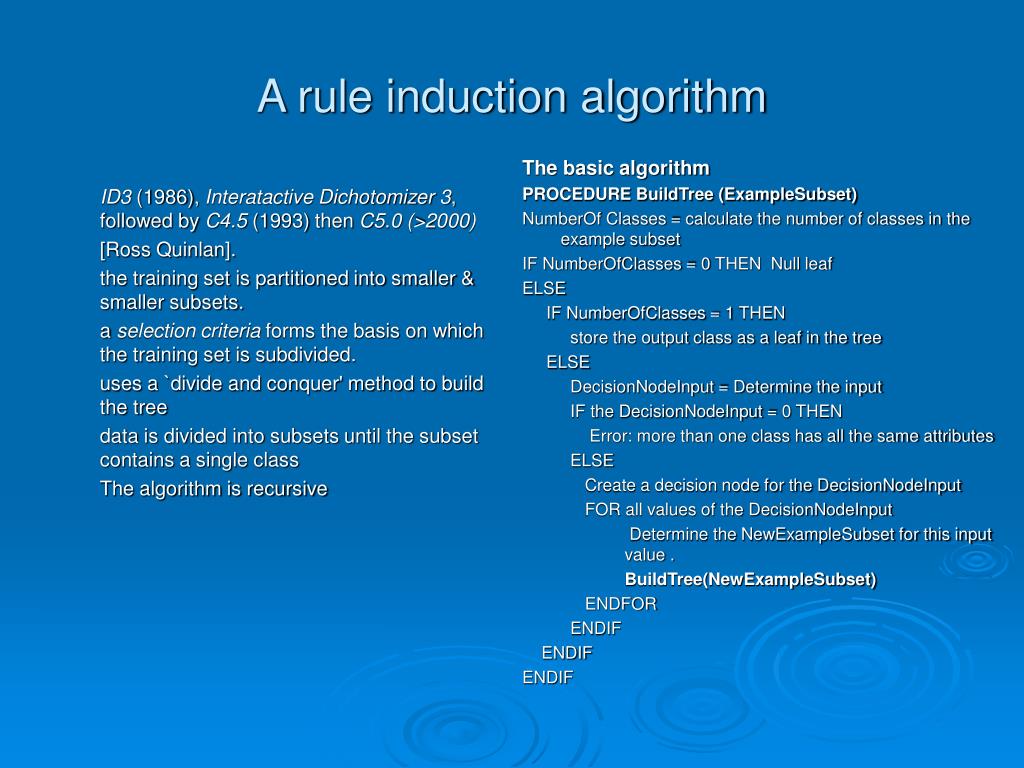
ID3 (1986), Interatactive Dichotomizer 3 , followed by C4.5 (1993) then C5.0 (>2000) [Ross Quinlan]. the training set is partitioned into smaller & smaller subsets. a selection criteria forms the basis on which the training set is subdivided.
A rule induction algorithm - slide 1
01 / 10A rule induction algorithm
1 / 17

Télécharger la présentation

A rule induction algorithm
Une image / un lien ci-dessous est fourni (tel quel) pour télécharger la présentation

Politique de téléchargement : le contenu du site vous est fourni TEL QUEL pour votre information et votre usage personnel ; il ne peut être vendu, concédé sous licence ni partagé sur d’autres sites sans l’accord de son auteur.Le contenu vous est fourni TEL QUEL, pour votre information et votre usage personnel uniquement. Téléchargez la présentation en cliquant sur ce lien. Lors du téléchargement, si vous ne parvenez pas à télécharger une présentation, l’éditeur a peut-être supprimé le fichier de son serveur.Pendant le téléchargement, si vous ne parvenez pas à obtenir une présentation, le fichier a peut-être été supprimé par l’éditeur.

F I N

Plus de contenu associé

Transcription de la présentation
  1. ID3 (1986), Interatactive Dichotomizer 3, followed by C4.5 (1993) then C5.0 (>2000) [Ross Quinlan]. the training set is partitioned into smaller & smaller subsets. a selection criteria forms the basis on which the training set is subdivided. uses a `divide and conquer' method to build the tree data is divided into subsets until the subset contains a single class The algorithm is recursive The basic algorithm PROCEDURE BuildTree (ExampleSubset) NumberOf Classes = calculate the number of classes in the example subset IF NumberOfClasses = 0 THEN Null leaf ELSE IF NumberOfClasses = 1 THEN store the output class as a leaf in the tree ELSE DecisionNodeInput = Determine the input IF the DecisionNodeInput = 0 THEN Error: more than one class has all the same attributes ELSE Create a decision node for the DecisionNodeInput FOR all values of the DecisionNodeInput Determine the NewExampleSubset for this input value . BuildTree(NewExampleSubset) ENDFOR ENDIF ENDIF ENDIF A rule induction algorithm

  2. An example (animal classification) 4 input attributes hair [T, F] swims [T, F] colour [white, brown, gray] size [small, medium, large] 3 Classes A = KANGAROO B = DOLPHIN C = WHALE # hair swims colour size CLASS 1 T F gray medium KANGAROO 2 T F brown medium KANGAROO 3 F T gray large DOLPHIN 4 F T white medium DOLPHIN 5 F T brown large WHALE 6 T F gray large KANGAROO The basic algorithm PROCEDURE BuildTree (ExampleSubset) NumberOf Classes = calculate the number of classes in the example subset IF NumberOfClasses = 0 THEN Null leaf ELSE IF NumberOfClasses = 1 THEN store the output class as a leaf in the tree ELSE DecisionNodeInput = Determine the input IF the DecisionNodeInput = 0 THEN Error: more than one class has all the same attributes ELSE Create a decision node for the DecisionNodeInput FOR all values of the DecisionNodeInput Determine the NewExampleSubset for this input value . BuildTree(NewExampleSubset) ENDFOR ENDIF ENDIF ENDIF A rule induction algorithm

  3. An example (animal classification) # hair swims colour size CLASS 1 T F gray medium KANGAROO 2 T F brown medium KANGAROO 3 F T gray large DOLPHIN 4 F T white medium DOLPHIN 5 F T brown large WHALE 6 T F gray large KANGAROO Order of attribute selection will be hair, swims, colour, size The basic algorithm PROCEDURE BuildTree (ExampleSubset) NumberOf Classes = calculate the number of classes in the example subset IF NumberOfClasses = 0 THEN Null leaf ELSE IF NumberOfClasses = 1 THEN store the output class as a leaf in the tree ELSE DecisionNodeInput = Determine the input IF the DecisionNodeInput = 0 THEN Error: more than one class has all the same attributes ELSE Create a decision node for the DecisionNodeInput FOR all values of the DecisionNodeInput Determine the NewExampleSubset for this input value . BuildTree(NewExampleSubset) ENDFOR ENDIF ENDIF ENDIF A rule induction algorithm

  4. An example (animal classification) # hair swims colour size CLASS 1 T F gray medium KANGAROO 2 T F brown medium KANGAROO 3 F T gray large DOLPHIN 4 F T white medium DOLPHIN 5 F T brown large WHALE 6 T F gray large KANGAROO Change order of attribute selection: hair, colour, swims,size The basic algorithm PROCEDURE BuildTree (ExampleSubset) NumberOf Classes = calculate the number of classes in the example subset IF NumberOfClasses = 0 THEN Null leaf ELSE IF NumberOfClasses = 1 THEN store the output class as a leaf in the tree ELSE DecisionNodeInput = Determine the input IF the DecisionNodeInput = 0 THEN Error: more than one class has all the same attributes ELSE Create a decision node for the DecisionNodeInput FOR all values of the DecisionNodeInput Determine the NewExampleSubset for this input value . BuildTree(NewExampleSubset) ENDFOR ENDIF ENDIF ENDIF A rule induction algorithm

  5. An example (animal classification) # hair swims colour size CLASS 1 T F gray medium KANGAROO 2 T F brown medium KANGAROO 3 F T gray large DOLPHIN 4 F T white medium DOLPHIN 5 F T brown large WHALE 6 T F gray large KANGAROO Change order of attribute selection: size, swims, colour, hair The basic algorithm PROCEDURE BuildTree (ExampleSubset) NumberOf Classes = calculate the number of classes in the example subset IF NumberOfClasses = 0 THEN Null leaf ELSE IF NumberOfClasses = 1 THEN store the output class as a leaf in the tree ELSE DecisionNodeInput = Determine the input IF the DecisionNodeInput = 0 THEN Error: more than one class has all the same attributes ELSE Create a decision node for the DecisionNodeInput FOR all values of the DecisionNodeInput Determine the NewExampleSubset for this input value . BuildTree(NewExampleSubset) ENDFOR ENDIF ENDIF ENDIF A rule induction algorithm

  6. Introduce a conflicting example (the `non swimming' smallish whale!) # hair swims colour size CLASS 1 T F gray medium KANGAROO 2 T F brown medium KANGAROO 3 F T gray large DOLPHIN 4 F T white medium DOLPHIN 5 F T brown large WHALE 6 T F gray large KANGAROO 7 T F gray medium WHALE Order of attribute selection: hair, colour, swims, size The basic algorithm PROCEDURE BuildTree (ExampleSubset) NumberOf Classes = calculate the number of classes in the example subset IF NumberOfClasses = 0 THEN Null leaf ELSE IF NumberOfClasses = 1 THEN store the output class as a leaf in the tree ELSE DecisionNodeInput = Determine the input IF the DecisionNodeInput = 0 THEN Error: more than one class has all the same attributes ELSE Create a decision node for the DecisionNodeInput FOR all values of the DecisionNodeInput Determine the NewExampleSubset for this input value . BuildTree(NewExampleSubset) ENDFOR ENDIF ENDIF ENDIF A rule induction algorithm Same as example 1

  7. A rule induction algorithm #1 2 3 4 5 6 7 The tree is Hair? T F #3 4 5 #12 6 7 colour? white colour? white gray gray NULL brown brown #1 6 7 swims? DOLPHIN T DOLPHIN WHALE KANGAROO F #3 #4 #2 #5 #1 6 7 NULL size? small large medium KANGAROO NULL #6 error #1 7

  8. A rule induction algorithm How might an algorithm of this type handle missing data? As the attribute value set has to be finite and discrete then the simplest way is to treat a missing value as an extra attribute value eg # hair swims colour size CLASS 1 T ? gray medium KANGAROO 2 T F brown medium KANGAROO 3 F T gray large DOLPHIN 4 F T white medium DOLPHIN 5 F T brown large WHALE 6 T F gray large KANGAROO The value set for swims now becomes {T, F, ?}

  9. The rule sets now be written down from the decision trees. For example IF hair = T THEN KANGAROO IF hair = F AND colour = white THEN DOLPHIN IF hair = F AND colour = brown THEN WHALE IF hair = F AND colour = gray THEN DOLPHIN A rule induction algorithm Hair? T F KANGAROO Colour? white gray DOLPHIN brown DOLPHIN WHALE

  10. A rule induction algorithm Comments: The choice of which attribute to split on is crucial The algorithm can deal with missing data The algorithm can deal with conflict, by flagging that it exists Next time …