Understanding Emotions: The Intersection of Physiology, Behavior, and Experience
Emotions are complex phenomena involving physiological arousal, behavioral responses, and personal experiences. Our bodies react to emotions through changes such as faster breathing, pupil dilation, and hormone release, all orchestrated by the autonomic nervous system. The Yerkes-Dodson Law outlines the balance needed between arousal and performance, highlighting the challenges in identifying emotions through physiological cues alone. Nonverbal communication plays a crucial role, with studies indicating that women are often better at detecting and expressing emotions than men. Cultural differences influence body language, yet facial expressions of basic emotions remain universal, hinting at an evolutionary basis. Theories of emotion, including the James-Lange theory and the Cannon-Bard theory, illustrate the intricate connection between physiological and emotional experiences.

Understanding Emotions: The Intersection of Physiology, Behavior, and Experience
E N D
Presentation Transcript
Emotion Psychology 1107
Introduction • Emotions are a mix of: • Physiological arousal of some sort • Behaviour • Experience
Physiology of emotion • Extra sugar is made available for energy • Breathe faster • Slowed digestion • Pupils dilate • Sweat • Autonomic nervous system kicks in • epinephrine • norepinephrine
The Yerkes Dodson Law • Too much arousal is not good • Too little arousal is not good • Somewhere in the middle is what you want • True for most tasks • Overlearned tasks, the more arousal the better
Emotions are a riddle • It is hard to pick out who is angry, scared or sexually aroused by physiological reactions alone • They feel different though • Different brain regions light up • Polygraphs work only on this stuff so it is hard to tell if people are guilty, or just generally aroused
Noverbal communication and emotion • Kellerman, Lewis and Laird (1989) • Body language affects emotions • Women tend to be better than men at detecting emotion • Women express happiness more easily • Men express anger more easily
Body language • Liars make fewer pauses, more gestures • There are cultural differences of course • Personal space • Gestures • Nixon’s famous gaffe • Facial expressions though seem to be culturally independent
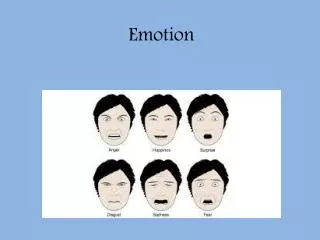
Facial expressions • Fear, anger happiness, disgust, surprise are the same everywhere • There is probably an evolutionary basis to this, indeed, chimps make expressions that are universal
Facial expressions and emotion • Oddly enough, our emotions can also feed off the expressions we are making (Duclas et al, 1989) • Forced people to ‘smile’ • Felt happier • Ekman’s work with actors
Experiencing emotion • Emotions seem to have a few dimensions to them • Pleasant vs. unpleasant • Arousal vs. sleepy • Long vs. short • Izzard (1977) said there are 10 emotions • Joy, excitement, surprise, sadness, guilt, anger, disgust, contempt, fear, shame • Said that other emotions are just combinations
Fear • Pretty adaptive, fight or flight • Learn to fear objects etc • Observation too • Nobody fears houses… • Amygdala may be key • Genetic effects too
Anger • Both other’s willful acts, and plain ol’ annoyances can make us angry • Seems maladaptive, but it often leads to a solution • Should you vent? • Catharsis • Usually does not work • Leads to more rage • Calm down! • Vent not through anger, but through exercise etc
Happiness • Happy people have better lives than non happy people • Wonder what the direction is though… • Even after bad stuff, happiness levels do not seem to change • It is all relative of course • We adapt to our lot in life
Theories of Emotion • James-Lange theory • Emotions come from physiological arousal • Happiness comes from smiling • Sadness comes from crying Perceived Event Physiological And Behavioural response Emotional Experience
Cannon-Baird Theory Physiological And Behavioural response • Emotion originates in the thalamus • Physiological and psychological systems activated simultaneously Perceived Event Emotional Experience
Schacter Two Factor • Physiological arousal and cognitive label happen • Both of which are required for an emotional experience Physiological Arousal Emotional Experience Cognitive Label