Data Annotation in Self-Driving Vehicles: Challenges and Solutions
0 likes | 15 Vues
In this PDF, we explore the complexities of annotating data for autonomous vehicles, highlighting the challenges faced and the solutions driving the development of smarter, safer self-driving cars. By partnering with specialized data annotation services like EnFuse Solutions in India, you gain access to expert annotators and advanced tools tailored to the needs of autonomous vehicle projects. Visit this link, to explore more: https://www.enfuse-solutions.com/


Data Annotation in Self-Driving Vehicles: Challenges and Solutions
E N D
Presentation Transcript
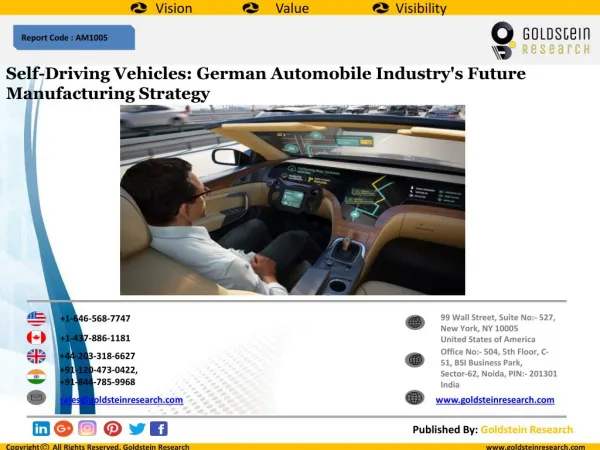
Data Annotation in Self-Driving Vehicles: Challenges and Solutions The swift progress of autonomous vehicle (AV) technology holds the potential to transform the transportation sector, offering increased safety, efficiency, and convenience. At the heart of this innovation lies data annotation, a crucial process for training AI models that drive self-driving cars. However, annotating data for AVs presents unique challenges that require specialized solutions. In this PDF, we delve into the complexities of annotating data for autonomous vehicles, examining the challenges encountered and the solutions advancing the development of smarter, safer self-driving cars.
The Importance of Autonomous Vehicles Data Annotation Annotating data plays a vital role in the development and training of AI models for autonomous vehicles. These models rely on annotated data to learn how to interpret and react to various driving scenarios. Autonomous vehicle sensor data, including inputs from cameras, LIDAR, and radar, needs precise labeling to ensure the AI can accurately identify objects, pedestrians, road signs, and other elements in real-time. Autonomous Driving Data Challenges 1. Complex Autonomous Vehicle Sensor Data:Autonomous vehicles rely on a multitude of sensors, including LiDAR, radar, and cameras, to perceive their surroundings. Each sensor generates vast amounts of data that must be accurately annotated. The complexity of this data, especially when combined with multiple sensors, makes the annotation process highly challenging. 2. Dynamic Environments: Unlike static images, the environment around autonomous vehicles is constantly changing. Annotators must accurately label objects that move in and out of the frame, which requires meticulous attention to detail and a deep understanding of motion dynamics. 3. Annotating AV Datasets: Autonomous vehicles produce immense volumes of data daily. Accurately annotating these vast datasets requires significant labor and time. Moreover, the data collected covers a wide range of scenarios—various weather conditions, different lighting situations, and numerous driving environments. Ensuring comprehensive coverage of all possible scenarios is essential for robust AI training for self-driving cars. 4. Quality and Consistency: Ensuring high-quality annotations across large datasets is critical for training reliable AI models. Inconsistent or inaccurate annotations can lead to poor model performance and safety issues.
Solutions for AV Data Annotation 1. Advanced AV Data Annotation Tools: Utilizing state-of-the-art AV data annotation tools can streamline the process. These tools often come with features like 3D point cloud visualization, automated object detection, and real-time collaboration, which enhance accuracy and efficiency. 2. AI-Assisted Annotation: Leveraging AI to assist human annotators can significantly speed up the annotation process. AI models can pre-label data, which annotators then review and correct, reducing the time and effort required for manual annotation. 3. Enhanced AI Training Techniques: AI training for self-driving cars benefits from advanced techniques like transfer learning, fine-tuning pre-trained models with new data, and active learning, where the AI identifies valuable data for annotation, enhancing training efficiency and reducing manual labeling needs. 4. Crowdsourcing: Utilizing crowdsourcing platforms to involve a wide range of annotators can assist in handling the extensive amount of data. By distributing the workload, crowdsourcing enables faster turnaround times while maintaining quality through rigorous validation processes. 5. Quality Control Mechanisms: Implementing robust quality control mechanisms is essential for maintaining annotation consistency. Methods like cross-validation, agreement among annotators, and automated quality assessments aid in detecting and correcting errors. 6. Specialized Annotation Services: Partnering with specialized data annotation services like EnFuse Solutions India, we can provide access to expert annotators and advanced tools tailored to the needs of autonomous vehicle projects. These services ensure high-quality, scalable, and cost-effective annotation solutions.
The Role of EnFuse Solutions India EnFuse Solutions India offers best-in-class data annotation services tailored for autonomous vehicles. With a team of experienced annotators and cutting-edge technology, EnFuse Solutions ensures that your AV datasets are accurately and efficiently annotated. Their comprehensive solutions address the unique challenges of AV data annotation, providing the quality and consistency needed to train reliable AI models for self-driving cars. Conclusion The quality of data used to train AI systems in autonomous vehicles is crucial for achieving reliable and safe self-driving technology. By utilizing advanced tools, expert annotators, AI assistance, continuous improvement, and specialized services like EnFuse Solutions India, the industry can confidently drive towards a safer and smarter transportation future, enhancing performance and enabling widespread adoption. For more insights into how EnFuse Solutions can elevate your AV data annotation efforts, reach out to us today. Read more:Crowdsourcing In Data Annotation: A Sustainable Model For Startups