Adding Real Numbers
This guide explains how to add real numbers using examples involving money. We'll explore the addition of positive and negative numbers through real-life situations: If you have $5 and receive $3, you get $8; if you owe $5 and borrow $3, you still owe money. We introduce rules for adding numbers with the same sign and those with opposite signs, illustrated with practical examples. Additionally, two methods for combining long strings of numbers are described, emphasizing mental calculations and simplicity.

Adding Real Numbers
E N D
Presentation Transcript
Adding Real Numbers Section 2-3-1
Think money. • 5 + 3 = 8 Up 5 , then up 3 more • If you have $5 in your pocket and are given $3 more, how much do you have? • -5 + (-3) = -8 Down 5 then down 3 more • If you owe $5 and then borrow $3 more, how much do you have?
Think what these two problems have in common. • 1. You had to add the 3 and the 5 to get the answer. • 2. The sign depended on the sign of the original numbers.
Rule: • To add numbers with the same sign, • ADD the numbers. • KEEP THE SIGN of the numbers involved.
Think the rule. • 5 + 3 = 8 • The signs are the same so 3 plus 5 is 8. Both numbers are positive so the answer is positive. • -5 + (-3) = -8 • The signs are the same so 3 plus 5 is 8.Both numbers are negative so the answer is negative.
Think money. • 5 + (-3) = 2 Up 5 then down 3 • If you have $5 in your pocket and you borrow $3, how much do you have? • -5 + 3 = -2 Down 5 then up 3 • If you owe $5 and then find $3, how much do you have?
Think • What these two problems have in common. • 1. You had to subtract the 3 from the 5 to get the answer. • 2. The sign depended on which was farther away from zero.
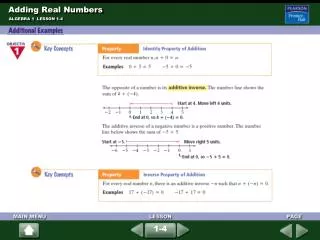
Rule: • To add numbers with opposite signs • Subtract the numbers. • Keep the sign of the number with the larger absolute value.
Think the rule. • 5 + (-3) = 2 • The signs are opposite so subtract. • 5 has the larger absolute value so the answer is positive. • -5 + 3 = -2 • The signs are opposite so subtract. • 5 has the larger absolute value so the answer is negative.
Method 1 • There are two ways to think about combining long strings of numbers. • Method 1: • Add all the positive numbers using the rule for like signs. • Add all the negative numbers using the rule for like signs. • Then combine the two results using the rule for opposite signs. • Add the positive numbers. Add the negative numbers. Combine the results.
Method 2: • Combine the numbers in order from left to right using the appropriate addition rule. • Notice these steps can be done in your head. It seems longer on paper, but if you can do it in your head it really isn’t.
Remember • 3x2 + 8x2 =11x2 • 3x2 +(- 8x2 )=-5x2