Difference Between PTFE and Expanded PTFE
In the world of industrial materials, PTFE (Polytetrafluoroethylene) and expanded PTFE (ePTFE) are two names that frequently come up. These materials are known for their remarkable properties and versatility, making them essential components in various industries. In this comprehensive guide, we will delve deep into the dissimilarities between PTFE and expanded PTFE, shedding light on their unique characteristics, applications, and the manufacturing processes that set them apart.<br>Visit: https://www.uniklinger.com/blog-detail/difference-between-ptfe-and-expanded-ptfe

Difference Between PTFE and Expanded PTFE
E N D
Presentation Transcript
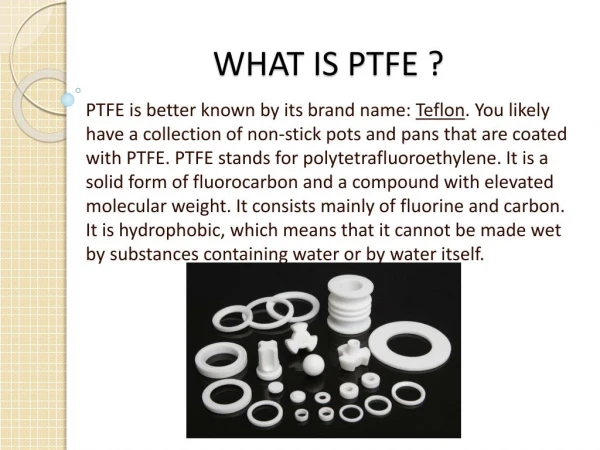
Difference Between PTFE and Expanded PTFE In the world of industrial materials, PTFE (Polytetrafluoroethylene) and expanded PTFE (ePTFE) are two names that frequently come up. These materials are known for their remarkable proper?es and versa?lity, making them essen?al components in various industries. In this comprehensive guide, we will delve deep into the dissimilari?es between PTFE and expanded PTFE, shedding light on their unique characteris?cs, applica?ons, and the manufacturing processes that set them apart. Visit @ h?ps://www.uniklinger.com/contact Sec?on 1: Understanding PTFE Polytetrafluoroethylene, commonly referred to as PTFE, is a synthe?c fluoropolymer discovered by Dr. Roy Plunke? in 1938. This white, waxy solid is renowned for its excep?onal proper?es: 1. Non-S?ck Surface: PTFE has a low coefficient of fric?on, which means it offers excellent non-s?ck proper?es. This feature has made it famous as the coa?ng for cookware like non-s?ck pans. 2. Chemical Resistance: PTFE is highly resistant to chemicals, acids, and solvents. This property makes it ideal for use in industries where exposure to corrosive substances is common. 3. High Temperature Stability: PTFE can withstand high temperatures without degrading, making it suitable for applica?ons involving extreme heat. (PTFE is stable and nontoxic at lower temperatures, it begins to deteriorate at temperatures of about 260 °C) 4. Electrical Insula?on: It has excellent electrical insula?on proper?es, which make it suitable for use in electrical and electronic applica?ons. 5. Low Fric?on: PTFE exhibits low fric?on, making it an excellent choice for bearings, seals, and gaskets. 6. Biocompa?ble: PTFE is biocompa?ble and used in medical applica?ons such as prosthe?c implants. 7. Manufacturing Process: PTFE is manufactured through a process involving the polymeriza?on of tetrafluoroethylene (TFE) gas at high temperatures. The resultant polymer is then processed into various forms, including sheets, rods, and tubes. Sec?on 2: Exploring Expanded PTFE (ePTFE) Expanded PTFE, or ePTFE, is a modifica?on of PTFE that takes the excep?onal proper?es of PTFE to a whole new level. This modifica?on involves a unique expansion process that imparts ePTFE with dis?nc?ve characteris?cs: 1. Porous Structure: The most notable difference between PTFE and ePTFE is the la?er's porous structure. This porous network is created during the expansion process, resul?ng in a material that is about 95% air by volume. 2. Increased Flexibility: ePTFE is more flexible than tradi?onal PTFE due to its porous structure, making it easier to conform to irregular surfaces.
3. Enhanced Sealability: The porous nature of ePTFE gives it superior sealability proper?es, making it an ideal choice for gaskets and sealing applica?ons. 4. Improved Compressibility: ePTFE is highly compressible, allowing it to maintain a seal even under low levels of compression. 5. Temperature Resistance: Like PTFE, ePTFE is highly temperature-resistant, but its enhanced flexibility and conformability make it suitable for sealing applica?ons even in extreme temperature condi?ons. 6. Non-Abrasive: ePTFE's porous structure makes it non-abrasive, which is crucial in applica?ons where abrasion could be a concern. 7. Manufacturing Process: The expansion process of PTFE involves hea?ng the material to a specific temperature and then rapidly cooling it. This creates a microstructure with nodes and fibrils, resul?ng in the characteris?c porous structure of ePTFE. Read Full Blog@ h?ps://www.uniklinger.com/blog-detail/difference-between-p?e-and-expanded-pt fe For More Informa?on Visit: www.uniklinger.com