Download
1 / 5
0 likes | 0 Vues
In India, a highly sophisticated and minimally invasive technique called PCNL Surgery (Percutaneous Nephrolithotomy) is used to remove large or complicated kidney stones. Modern hospitals, skilled urologists, and reasonably priced prices in comparison to Western nations have made India one of the top locations for this treatment.

E N D
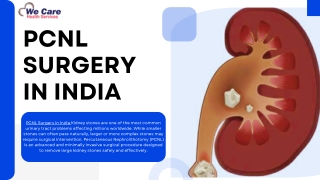
PCNL SURGERY IN INDIA PCNL Surgery in India Kidney stones are one of the most common urinary tract problems affecting millions worldwide. While smaller stones can often pass naturally, larger or more complex stones may require surgical intervention. Percutaneous Nephrolithotomy (PCNL) is an advanced and minimally invasive surgical procedure designed to remove large kidney stones safely and effectively.
What is PCNL Surgery? PCNL (Percutaneous Nephrolithotomy) is a surgical procedure performed to remove large kidney stones that cannot pass naturally or be treated with other methods like ESWL (Extracorporeal Shock Wave Lithotripsy) or ureteroscopy.
Types of PCNL Surgery WHEN IS PCNL SURGERY RECOMMENDED? Standard PCNL 01 Doctors when: Kidney stones are larger than 2 cm in diameter Stones are hard or irregularly shaped Stones cause blockage of urine flow Stones are infected or associated with repeated infections (UTIs) Other treatments have failed, such as ESWL or medication There are multiple stones in one or both kidneys usually recommend PCNL Used for large or complex stones. Involves a slightly larger tract and instruments for efficient stone removal. Mini-PCNL 02 Uses smaller instruments and a smaller incision. Suitable for moderately large stones. Less postoperative pain and faster recovery. urinary tract Ultra-Mini or Micro-PCNL 03 Performed using micro-endoscopic tools for smaller stones. Minimal tissue damage, ideal for pediatric and delicate cases.
TARGET AUDIENCE 1. Preoperative Preparation A detailed medical evaluation and imaging tests (CT scan, ultrasound, or X-ray) are performed to locate the stones precisely. The patient is given general anesthesia or regional anesthesia. Antibiotics may be prescribed to prevent infection. By targeting these diverse audience segments, marketing agency ensures a customized and approach that aligns with the specific needs and goals of each client. 2. Making the Incision our impactful A small incision is made in the back, near the kidney area. A thin guide wire is passed into the kidney under imaging guidance (fluoroscopy or ultrasound). 3. Inserting the Nephroscope A nephroscope (a thin viewing instrument) is inserted through the incision to visualize the kidney and locate the stone. The surgeon uses tiny instruments to grasp or break the stones into smaller fragments. Thynk Unlimited
THANK YOU CONTACT US: wecarehealthservices90@gmail.com www.indiahealthtour.com +91 9029304141