Understanding Diversity And How It Affects Teaching And Learning - Part 1
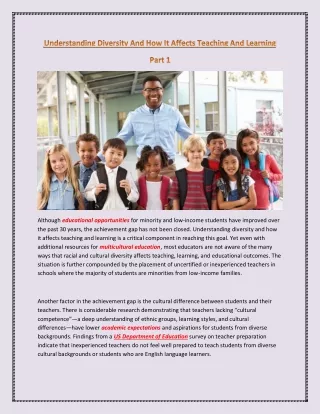
Although educational opportunities for minority and low-income students have improved over the past 30 years, the achievement gap has not been closed. Understanding diversity and how it affects teaching and learning is a critical component in reaching this goal. Yet even with additional resources for multicultural education, most educators are not aware of the many ways that racial and cultural diversity affects teaching, learning, and educational outcomes. The situation is further compounded by the placement of uncertified or inexperienced teachers in schools where the majority of students are minorities from low-income families. Another factor in the achievement gap is the cultural difference between students and their teachers. There is considerable research demonstrating that teachers lacking u201ccultural competenceu201du2014a deep understanding of ethnic groups, learning styles, and cultural differencesu2014have lower academic expectations and aspirations for students from diverse backgrounds. Findings from a US Department of Education survey on teacher preparation indicate that inexperienced teachers do not feel well prepared to teach students from diverse cultural backgrounds or students who are English language learners. One strategy for improving the quality of teaching for diverse learners is to diversify the teaching profession: The typical teacher is young, white, female, a recent college graduate with limited contact or experience with people of other races or cultures. Researchers argue that students are better served by teachers who share their cultural and social backgrounds, since it is assumed those teachers will have greater cultural awareness and understanding, higher aspirations for student achievement, and the ability to provide positive role models. Recruiting teachers from diverse backgrounds, however, does not sufficiently address the challenge of meeting the needs of diverse learners. First, there are not enough teachers of diverse backgrounds to go around. While the percentage of minority children in schools has increased, the percentage of minority teachers has not kept pace. In addition, the student population has become increasingly diverse on a variety of levels, making it highly unlikely that any one teacher would have the same cultural and racial background as the students in the class. Broad changes in pre-service teacher education programs are needed to produce teachers who are effective with a diverse student body. These changes include recruiting teachers who are committed to multicultural education, integrating diversity throughout the undergraduate curriculum, and providing clinical experiences that immerse teacher candidates in the communities of their prospective students. Because so many teachers begin teaching without the opportunity to develop the skills and knowledge needed to teach diverse students, ongoing professional development in diversity is essential. Unfortunately, diversity professional development tends to be sporadic and disjointed, and is more likely to focus on attitude change (cultural awareness) than on skill development. How New Teachers Deal with Diversity Overall, new teachers in the survey held positive attitudes toward cultural diversity. The teachersu2014the majority of whom are young (70 percent were age 35 or under) white (78 percent) women (77 percent)u2014did not consider schools with a predominantly non-white student population to be u201cdiverse,u201d even when the background of the teaching staff differed from that of the students. The teachers also had a tendency to view diversity in terms of individual student differences, and worked on addressing the individual interests, needs, and aptitudes of their students. Teachers seldom mentioned diversity in terms of social and educational equity, and very few described students as members of racial, cultural, or linguistic groups that, historically, have been treated inequitably by the education system. Many indicated they felt well prepared to understand the culture and background of their students and to teach their subject areas in ways that help all students learn. However, the same teachers also said they felt least prepared to address the needs of English language learners or students with special learning needs, a pattern that held true not only for teachers in the study, but also for those participating in prior studies as well. These findings indicate a disconnect between the way teachers view culture and the way they view language, raising the question of whether teachers really understand what it means to teach all children. Across all sites, teachers felt that socioeconomic diversityu2014in particular, povertyu2014and academic diversity had more of an effect on their teaching and on student learning than did race or culture. They viewed their lack of preparation in dealing with English language learners and special-needs students in terms of academic diversity, but did not link academic diversity to race or culture. The level of awareness among teachers of how their racial and cultural backgrounds might affect their teaching and their relationships with students varied significantly. Most teachers did not mention the issueu2014even those describing their student population as predominantly African American and the teaching staff as predominantly whiteu2014while others were very conscious of how the nuances of cultural difference affected their teaching. Some teachers said they felt more comfortable with their students if they shared the same race/culture and lived in the same community, and acknowledged that they may not have the necessary preparation to teach children of other races or cultures. Teachers also felt it was important for schools to make a greater effort to recruit teaching staff that reflected the student body. They felt that white teachers had to work harder to establish trusting relationships with students of color and that non-white teachers seemed to be able to develop u201cpositiveu201d and u201cdifferentu201d connections with students of color. Teachers with greater diversity awareness felt it was important for all teachers to spend time learning how to relate to students of various racial and cultural backgrounds. They felt teachers need to be more proactive and self-reflective in obtaining a better understanding of how their background and experiences might affect their teaching. Since good student-teacher relationships are a key to academic success, teachers felt they should have the opportunity to learn about their students and to work in the community before they entered into formal teacher-student relationships. Interestingly, these teacher perspectives are supported by research on the integral components of teacher diversity preparation. Diversity Preparation Teachers felt their formal pre-service training did little to prepare them for teaching a diverse student population. Typically, discussion about diversity was the extent of their training. Teachers felt the best pre-service preparation was student teaching in schools with racially and culturally diverse student populations. In the absence of formal training, they drew upon personal life experiences. Some teachers had traveled extensively; some had lived and taught overseas. Older teachers either had previous job experience working with children of similar backgrounds or felt their accumulated life experiences prepared them for understanding and relating to all kinds of students. Similarly, teachers growing up in urban areas among different races and cultures felt this background contributed to their understanding of and preparation for working with diverse student populations. Most teachers said they learned about teaching diverse student populations on the job. Some familiarized themselves with the backgrounds of their students by doing research on specific cultures or reading about teaching in diverse settings. Once they felt they had an understanding of their studentsu2019 backgrounds, interests, needs, and aptitudes, they then tried to figure out how to differentiate the curriculum to meet the needs of individual students. They relied mainly on trial and error, and received little structured assistance to achieve this goal. Diversity Support According to the survey findings, about a third (32 percent) of the new teachers did not think their induction programs had any impact when it came to teaching a diverse student population; more than half (55 percent) felt the program had no impact on teaching English language learners. During the interviews, the teachers said they had few professional development opportunities and limited support for teaching diverse learners. Diversity workshops were the most common form of professional development. In Seattle, diversity workshops are a standard component of the induction process for new teachers. While teachers generally held a positive view of the workshops, most felt they did not offer much in the way of actual classroom practice. Some teachers said their mentors helped them translate what they learned in the workshops into classroom practice. Mentors, peers, and administrators sometimes shared personal knowledge of individual students and their backgrounds, and new teachers found this to be useful. Teachers felt that addressing diversity should be a goal of the entire school, not something left up to individual teachers. The extent to which a focus on diversity was part of the school culture either supported or impaired teacher efforts to address diversity in the classroom. Teachers pointed to aspects of school cultureu2014low expectations of students of color and of those from poor familiesu2014that reinforce the cycle of poverty by asking less of certain students. School policies that labeled, separated, and tracked students with special needs, or those having learning problems, were seen as running counter to the efforts of individual teachers to promote effective teaching in their classrooms. Although teaching special education students was challenging, teachers also found it to be a valuable learning experience. Teachers that had experience in special education felt they were able to draw upon that experience to teach academically diverse learners in general education classes. Academic Diversity Support Teachers struggled to meet the needs of diverse learners. While most felt they made progress as the year progressed, they also voiced frustration at the lack of instructional supports available to them. One teacher commented that half her class was bilingual and required an instructional assistant, but the assistant was frequently pulled out of the classroom to chaperone field trips and do other things. Another teacher felt she was not given adequate time or materials to teach effectively; she wanted fewer students, more classroom support, and less paperwork. For the most part, teachers were left on their own to address academic diversity. Using trial and error, they introduced techniques they hoped would be effective and then evaluated how well the techniques worked with individual students. Observing and/or working with other teachers was another strategy new teachers employed. Several teachers found that the best way to address student differences was to find out as much about the students as possible and use this information as the basis for instruction. For the most part, teachers had to come up with their own strategies for developing, implementing, and assessing what instructional strategies were effective with different types of learners. They felt hands-on instructional approaches worked with an array of learning styles. A technology teacher felt she was able to reach a diverse student population, because technology is a great medium for instruction and holds a high degree of interest for students, particularly those who do not have access to computers at home. Jeff C. Palmer is a teacher, success coach, trainer, Certified Master of Web Copywriting and founder of https://Ebookschoice.com. Jeff is a prolific writer, Senior Research Associate and Infopreneur having written many eBooks, articles and special reports. Source: https://ebookschoice.com/understanding-diversity-and-how-it-affects-teaching-and-learning-part-1/
81 views • 6 slides