Enhancements in PTF-2: Revolutionary FOV Increase and Rapid SN Detection Capabilities
40 likes | 145 Vues
The PTF-2 project aims to significantly enhance the PTF mission with a field of view (FOV) increase by 4.5 to 6 times, maintaining a vigorous nightly cadence even during dark periods. With STA-ITL CCDs, we can achieve over 70% throughput in the U-band, improving detectability for phenomena like supernovae (SNe). We expect to detect approximately 300 core-collapse SNe annually, with half occurring during dark times. Given optimal conditions, as much as 50% may be discovered within a day of explosion, and 10% within hours.


Enhancements in PTF-2: Revolutionary FOV Increase and Rapid SN Detection Capabilities
E N D
Presentation Transcript
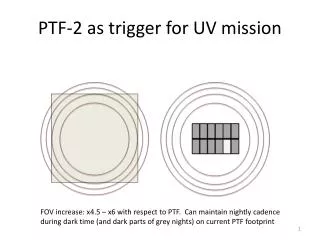
PTF-2 as trigger for UV mission FOV increase: x4.5 – x6 with respect to PTF. Can maintain nightly cadence during dark time (and dark parts of grey nights) on current PTF footprint
QEs STA-ITL CCDs can offer very high (>70%) throughput in U while still decent all the way to R. Substantial improvement (unique capability).
Detectability PTF can detect SNe on day 1 and react. PTF-2 will be much better. Young SNe (at least) are easier to detect in U (x5 – x10 more flux).
We know the PTF core-collapse yearly SN number, which is ~150. Given larger area (but denser sampling) of PTF-2, the yearly number would be ~300, of which 50% during dark time (U-band survey), so 150 a year, again. Given weather, about 50% should be discovered within a day of explosion, and ~10% within hours of explosion. Target numbers