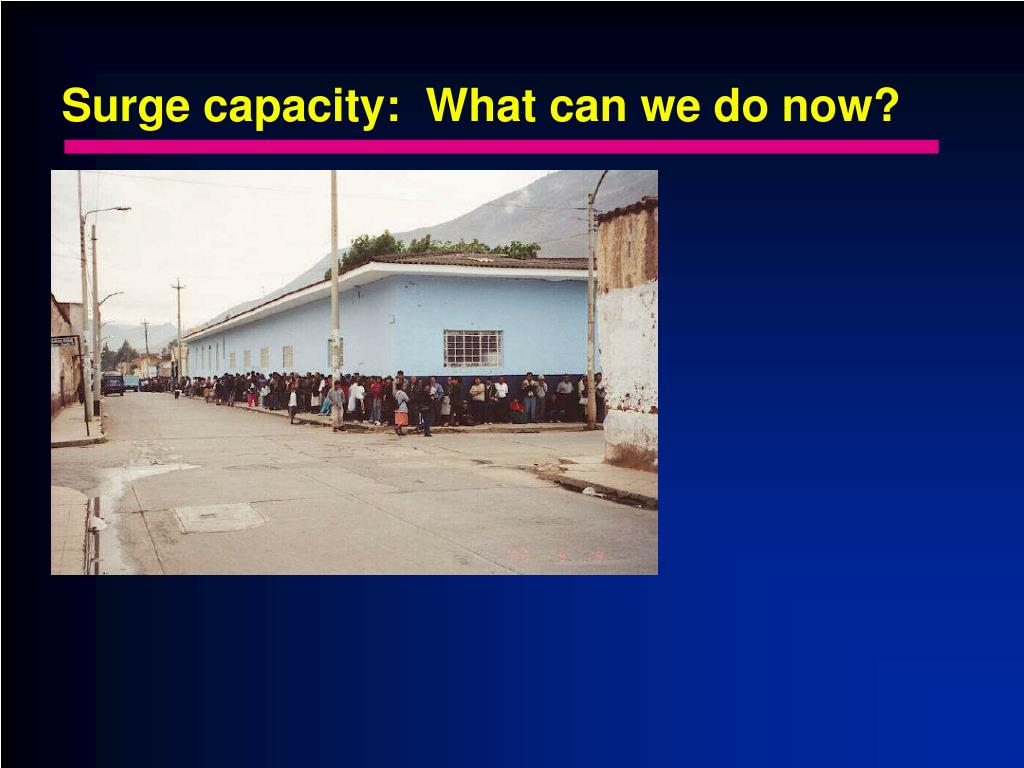
Surge capacity: What can we do now?. Surge capacity?. Do we need a disaster to make it happen?. The morning report vs. ED holds. Answer. Simple Costs nothing Makes money Increases safety Improves nurse/patient staffing ratios. Not …. Why did this happen?.
Une image / un lien ci-dessous est fourni (tel quel) pour télécharger la présentation
Politique de téléchargement : le contenu du site vous est fourni TEL QUEL pour votre information et votre usage personnel ; il ne peut être vendu, concédé sous licence ni partagé sur d’autres sites sans l’accord de son auteur.Le contenu vous est fourni TEL QUEL, pour votre information et votre usage personnel uniquement.Téléchargez la présentation en cliquant sur ce lien.Lors du téléchargement, si vous ne parvenez pas à télécharger une présentation, l’éditeur a peut-être supprimé le fichier de son serveur.Pendant le téléchargement, si vous ne parvenez pas à obtenir une présentation, le fichier a peut-être été supprimé par l’éditeur.
Properly categorize the problem • EMTALA • the poor • the safety net • The unnecessary visit – who else complains? • Subtext – the poor • SHOOT THE MESSENGER • What’s the SCIENCE?? • Temporary problems … or ….. • Too many inpatients in the ED !!!!
Strategies for the fix and the blame • Ambulance diversion • Transfer • Triage out • EMTALA, the poor, the safety net • The unnecessary visit • Temporary problems • Data data data Send our business away Strategy of victimization, race, and tragic heroes Strategy of ignoring the problem Strategy of beating the problem to death
Rules of the road • It should help ALL of the patients, not the ED • Operating principle: ED is necessary • ED CANNOT bear brunt of the deficiencies of the entire health care industry • Inpatients don’t belong in the ED • ED provides LOUSY care of inpatients • The insecurity-driven scam • The problem and the solution should be moved out of the ED
Implementing the rules of the road • Fix the problems you can • No excuses from problems you can’t • The ED is currently PREVENTING the solution to the problem • Discharge planning • Bed availability • “Safety”≠ “Happy” • Leadership COUNTS
An ED designed with monitors by each bed because of the unpredictable needs of incoming patients does not mean it is automatically an ICU or telemetry inpatient unit. The willingness of emergency physicians to cope with just about anything is not a virtue if this situation is the result. Mark Henry
What your ED does for you • AD Little community survey • 5 vs. 40 • Keep the hospital full • Financial • 1 more • Trauma center With bad service, who leaves?
x x x x x x x HUGE inpatient areas Itsy-bitsy ED x x x x x x x x x x x x x x x x Everything is filled to the brim
x x x x x x x x x Current model x x x x x x x x x x x x x x x x x x x x x x x x x
Current model • Core measure: Timely administration of antibiotics • Core measure: Door to balloon time • Timely treatment of strokes • Patient satisfaction Inadequate staff Inadequate space Lots of meetings
x x x x x x x x +/- Radically new model – 1970’s x x x x x x x x x x x nasty nice
WHY can’t we make it happen? • “Against the rules” • “DOH won’t allow” • OB OB OB ED ED ED • “That’s the way things are done” • Generational indoctrination • Reinforcement via the fire extinguisher • Keep the chaos IN the ED
DOH April 2002 • “continuing issue of hospital overcrowding” • “Emergency Departments must remain open” • “Maintaining admitted patients within the ED is not acceptable” • “the use of beds in solariums and hallways near nursing stations should be considered” • “Regardless of location within the facility, staffing, services, privacy, infection control and confidentiality protections must be consistently in place” www.viccellio.com/overcrowding.htm
Where leadership meets the road…. • Implementation of full capacity protocol • A hallway -> a hallway? • Leadership Concerns • Nobody does this • Not safe • Nurses will quit YOU are a leader EITHER WAY.
Yes, Because…….. • Inpatient Units are: less crowded, less noisy, less chaotic • Inpatient Units provide appropriate clinical expertise (MD’s, RN’s) • Staging in an inpatient hallway will result in closer, therefore faster access to a room
Full capacity Protocol: How it Works • Step 1 : ED attending in collaboration with ED charge nurse identify need for protocol to bed coordinator • Step 2: Bed coordinator gains approval from Medical Director or designee • Step 3: Bed coordinator notifies Clinical Associate Directors and the Inpatient Units that Full Capacity Protocol is being implemented • Step 4: Units assigned hallway patients. No unit will receive mote than 2 hallway patients.
Priority of Hallway placement • Non-telemetry patients with little or no co-morbidity • Non-telemetry patients with minimal or moderate co-morbidity • Telemetry patients as follows: • Little or no co-morbidity • Low index of suspicion for cardiac event • ED attending approval • Telemetry box availability and central monitoring slot
Exclusions to Hallway Placement • Patients requiring step-down or ICU • Rule-in MI or at high risk for cardiac event • Ventilator dependent patients • Patients requiring negative pressure or Isolation rooms • Patients requiring greater than 4 liters of O2 via nasal cannula
The Impact of Calling Full Capacity Protocol? • Expedited mobilization of resources to discharge patients • Nursing influence results in physician practice change • Improved communication between departments • Those areas not subject to FCP continue the same inability to improve
Connexion au compte
Connectez-vous pour publier votre contenu sur SlideServe.