
The Internet
E N D
Presentation Transcript
The Internet Making a Connection: Packet Switching, Addressing and Routing
Host Computer or Terminal An Internet Router Learning in Retirement - The Evolution of the Web
The Internet • The Internet, or more correctly, • a digital packet-switched network using the TCP/IP set of protocols, • is • A collection of hosts (computers and other information devices) • connected by a variety of digital communications networks, consisting of • digital communication links and • switches, which are called routers. Learning in Retirement - The Evolution of the Web
Protocols • Information is transmitted on the Internet as binary information, 1’s and 0’s, under the control of standardized procedures called protocols. Learning in Retirement - The Evolution of the Web
The TCP/IP Suite of Protocols • Originated with ARPANET and DDN to meet US DoD requirements • Survivability • no central point of failure security • Network interoperability • accommodate heterogeneous networks and equipment • Ability to handle surge traffic • Allow priority • Be always available Learning in Retirement - The Evolution of the Web
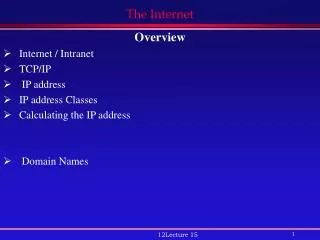
Sending Information on the Internet • Every entity (computer or router) on the Internet has an address. • The address is a 32-bit binary number • 10000110010101011111111011100011 • The IP address is usually expressed in dotted decimal form • 134.117.254.227 • Part of the address is the NetID and the remainder the HostID Learning in Retirement - The Evolution of the Web
Packets • The message to be sent is packaged into packets • A packet is a like an envelope that holds a block of data • Each packet includes • The address of the sender • The address of the destination Learning in Retirement - The Evolution of the Web
If the message is short • it is sent in one packet • If not • it is fragmented and • sent in a secession of packets. Learning in Retirement - The Evolution of the Web
Routing (Switching) • Packets are sent independently from router to router • Each router determines the next router to be used by consulting a local directory called a routing table Learning in Retirement - The Evolution of the Web
Routing at Host • If the NetID is the same as that of the originating host, the packet is handled locally • IP address is converted to the physical address of the host and the packet delivered • If not the same, a memory-resident routing table is consulted to determine next recipient of the packet Learning in Retirement - The Evolution of the Web
Routing at Router • The NetID is analyzed to determine if this is last hop. • If not, the IP of the local router (using memory-resident tables) selects the best path to the destination • Packet is encapsulated again and sent one hop closer to final destination • And so on Learning in Retirement - The Evolution of the Web
Routing Information • Hosts maintain sufficient information to forward packets to other hosts or interior routers within the same network • Interior routers maintain sufficient information to forward packets to hosts within the same system • Exterior routers maintain sufficient information to forward packets to other interior or exterior routers Learning in Retirement - The Evolution of the Web
Routing Tables • Each router keeps its memory-resident tables with an optimum path to every destination in the system • Routing-table update involves exchange of routing table information between routers using a built-in data communications system called ICMP. • Every router in the Internet does this call the time!!!! Learning in Retirement - The Evolution of the Web
Internet Control Message Protocol: ICMP • Provides feedback about problems in the communications environment • Error reporting • Reachability testing • Congestion Control Learning in Retirement - The Evolution of the Web
Datagram Delivery Learning in Retirement - The Evolution of the Web
Error Control • The network makes no effort to detect or correct errors in the transmitted data. • It is up to the recipient to detect errors and ask for retransmission. • This end-to-end task is handled by TCP, or the Transmission Control Protocol Learning in Retirement - The Evolution of the Web
Transmission Control Protocol (TCP) • TCP provides traditional connection oriented data communications service to programs - the reliable stream transport service • TCP provides a virtual circuit, called a connection • provides flow control, error checking and interrupt capability Learning in Retirement - The Evolution of the Web
TCP Services • Multiplexing • Connection Management • establish • maintain • terminate • Data Transport • Full-duplex • Timely • Ordered • Labeled • Flow controlled • Error checked Learning in Retirement - The Evolution of the Web
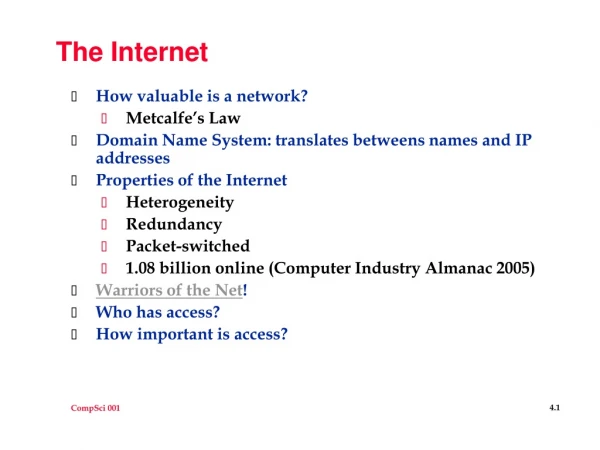
The Domain Name Service - DNS • DNS is a hierarchical collection of directories (databases) that play a vital role in the Internet. • DNS is the directory of IP addresses, that contains the names associated with IP addresses. • Names, like sce.carleton.ca allow people to use the Internet. Learning in Retirement - The Evolution of the Web
Finding an IP Address • When ask my browser to open a web page at www.sce.carleton.ca, a query is sent by my computer to the nearest DNS server (at my ISP) • If it knows the IP address it sends it back to my computer, otherwise it sends a query to the next level DNS server, maybe .ca • This continues until an answer is found or not. Learning in Retirement - The Evolution of the Web
When a match is found, say 134.117.4.60 or whatever, the IP address is sent to my computer, which sends a connect message to the web site using this IP address. • Every interaction with the Internet goes through the same process. • How can the Internet sustain – and increase - its capacity???? Learning in Retirement - The Evolution of the Web
THE INTERNET TCP/IP PROTOCOLS PACKET-SWITCHED NETWORKS email: Simple Mail Transport Protocol (SMTP) File Transfer Protocol (FTP) telnet: remote terminal access Internet Control Message (ICMP) Protocol DNS Domain Name Service Learning in Retirement - The Evolution of the Web
Moving on Learning in Retirement - The Evolution of the Web
Paths to Evolution • Fundamental Technologies • Electronics • Communications • Software • Systems Engineering • Provide better ways • to organize and use • faster processors with • more memory • at lower cost Learning in Retirement - The Evolution of the Web