Understanding Ionic Compounds and Simple Molecular Compounds
This overview explores the characteristics of ionic compounds, which consist of cations and anions and are electrically neutral due to equal positive and negative charges. We discuss examples of simple ionic compounds and introduce polyatomic ions, including how they combine with metal and nonmetal ions. The guide also covers naming conventions and formula representation for both ionic and simple molecular compounds, providing essential examples to reinforce learning. Learn about prefixes for molecular compounds and expand your chemistry knowledge!

Understanding Ionic Compounds and Simple Molecular Compounds
E N D
Presentation Transcript
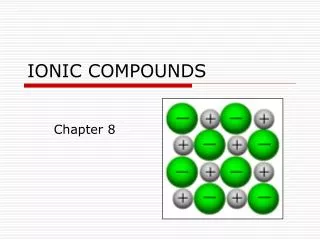
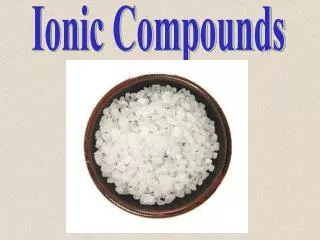
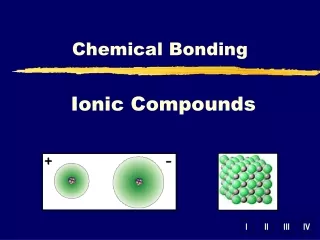
Ionic Compounds • composed of cations + anions • electrically neutral • the total positive charge equals the total negative charge • formula units • usua lly solid at room temperature • have high melting points
Simple Ionic Compounds Metal ion + Nonmetal ion salt Examples Be+2 + N -3 Be3N2 Fe+3+ Cl -1 FeCl3 Subscript shows number of atoms present in formula unit
Polyatomic Ions Collections of tightly bound atoms that behave as a unit and carry a charge examples SO3-2sulfite ion SO4-2 sulfate ion NO2 -2nitrite ion NO3-1 nitrate ion ClO2-1 chlorite ion ClO3-1 chlorate ion
Ionic Compounds with Polyatomic Ions • Metal ion + Polyatomic ion or • Polyatomic ion + nonmetal ion • examples • Na+1 + SO4-2Na2SO4 • Mg+2 + NO3-1 Mg(NO3)2 • NH4+1 + N -3 (NH4)3 N Oh no parentheses!
Given a formula, what’s the compound’s name? e.g. Be2C NH4MnO4 Al2(C2O4)3 H2SO4
Given a compound’s name, what is its formula? e.g. ammonium sulfite phosphoric acid calcium chloride iron (III) nitrite
Practice, practice, practice name formula formula name
Simple Molecular Compounds • Composed of two non-metallic compounds • Uses prefixes to indicate the number of atoms in the molecule • mono, 1 • di, 2 • tri, 3 • tetra, 4 • penta, 5 • hexa, 6 • hepta, 7 • octa, 8 • nona, 9 • deca 10
Simple Molecular Compounds examples: formula name CO carbon monoxide CO2 carbon dioxide N2O dinitrogen monoxide Cl2O3 dichloro trioxide SF6 sulfur hexafluoride
More Simple Molecular Compounds examples: name formula nitrogen trifluoride NF3 phosphorus trichloride PCl3 carbon tetrachloride CCl4