Understanding Ionic Compounds: Bond Formation, Lewis Structures, and Nomenclature
This guide covers key concepts in ionic bonding and nomenclature. It explains lattice energy as the energy released during the formation of an ionic crystalline compound from gaseous ions. It details how to draw Lewis structures, highlighting the differences between covalent and ionic bonds. The guide also presents systematic methods for writing ionic formulas, focusing on charge balance and the use of parenthesis for polyatomic ions. Additionally, it explains naming conventions for common ions, including suffix changes and Roman numeral usage.

Understanding Ionic Compounds: Bond Formation, Lewis Structures, and Nomenclature
E N D
Presentation Transcript
Chemical Bonding Ionic Compounds
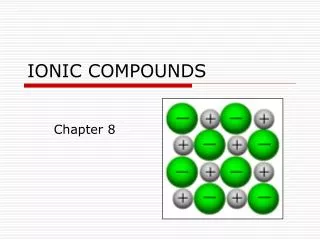
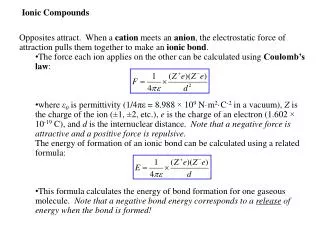
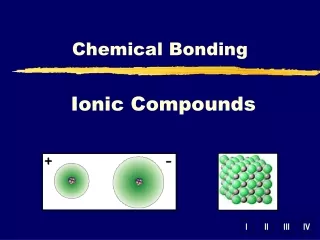
A. Energy of Bond Formation • Lattice Energy • Energy released when one mole of an ionic crystalline compound is formed from gaseous ions
B. Lewis Structures • Covalent – show sharing of e- • Ionic – show transfer of e-
B. Lewis Structures • Covalent – show sharing of e- • Ionic – show transfer of e-
C. Ionic Nomenclature Ionic Formulas • Write each ion, cation first. Don’t show charges in the final formula. • Overall charge must equal zero. • If charges cancel, just write symbols. • If not, use subscripts to balance charges. • Use parentheses to show more than one polyatomic ion. • Stock System - Roman numerals indicate the ion’s charge.
C. Ionic Nomenclature Ionic Names • Write the names of both ions, cation first. • Change ending of monatomic ions to -ide. • Polyatomic ions have special names. • Stock System - Use Romannumerals to show the ion’s charge if more than one is possible. Overall charge must equal zero.
C. Ionic Nomenclature • Consider the following: • Does it contain a polyatomic ion? • -ide, 2 elements no • -ate, -ite, 3+ elements yes • Does it contain a Roman numeral? • Check the table for metals not in Groups 1 or 2. • No prefixes!
C. Ionic Nomenclature Common Ion Charges 3+
C. Ionic Nomenclature • potassium chloride • magnesium nitrate • copper(II) chloride KCl • K+ Cl- • Mg2+ NO3- Mg(NO3)2 CuCl2 • Cu2+ Cl-
C. Ionic Nomenclature • NaBr • Na2CO3 • FeCl3 • sodium bromide • sodium carbonate • iron(III) chloride