SlideServe
Menu
Préférences
© SlideServe · v2026

Organic Chemistry 6 th Edition Paula Yurkanis Bruice

acton-gates avatar
59 diapositives · 1.3K Views · Nov 14, 2014

Organic Chemistry 6 th Edition Paula Yurkanis Bruice. Chapter 23 The Organic Chemistry of Amino Acids, Peptides, and Proteins. Peptides and proteins are polymers of amino acids linked together by amide bonds:. Classification of Amino Acids.
Organic Chemistry 6 th Edition Paula Yurkanis Bruice - slide 1
01 / 59Organic Chemistry 6 th Edition Paula Yurkanis Bruice
1 / 17

Télécharger la présentation

Organic Chemistry 6 th Edition Paula Yurkanis Bruice
Une image / un lien ci-dessous est fourni (tel quel) pour télécharger la présentation

Politique de téléchargement : le contenu du site vous est fourni TEL QUEL pour votre information et votre usage personnel ; il ne peut être vendu, concédé sous licence ni partagé sur d’autres sites sans l’accord de son auteur.Le contenu vous est fourni TEL QUEL, pour votre information et votre usage personnel uniquement. Téléchargez la présentation en cliquant sur ce lien. Lors du téléchargement, si vous ne parvenez pas à télécharger une présentation, l’éditeur a peut-être supprimé le fichier de son serveur.Pendant le téléchargement, si vous ne parvenez pas à obtenir une présentation, le fichier a peut-être été supprimé par l’éditeur.

F I N

Plus de contenu associé

Transcription de la présentation
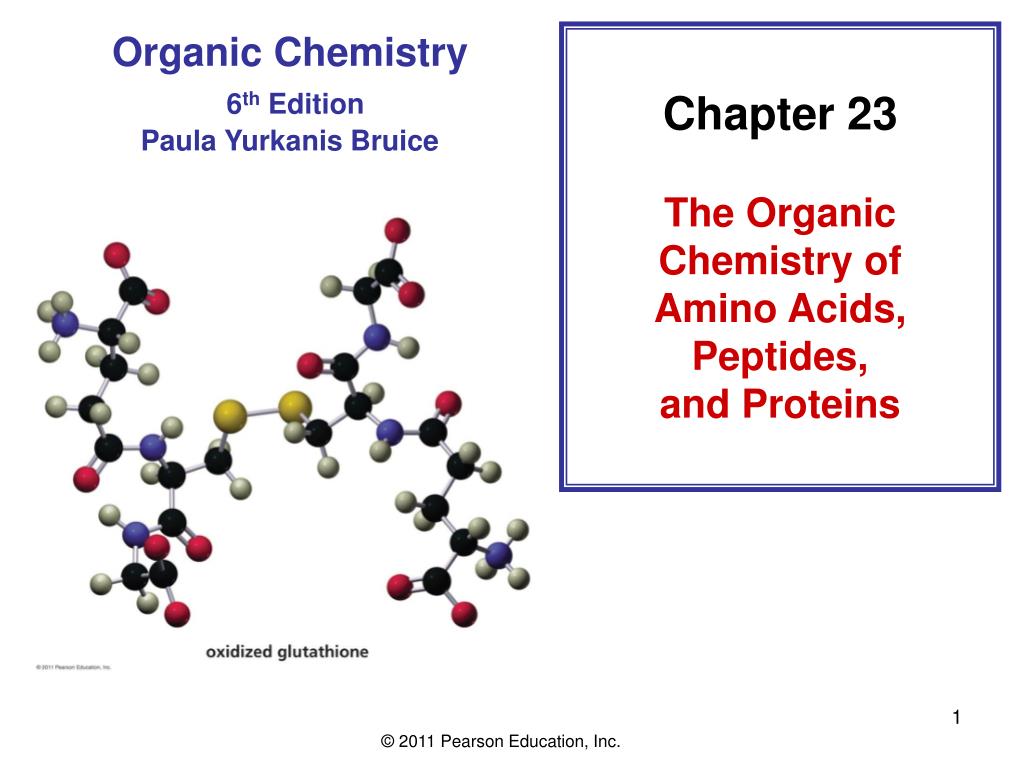
  1. Organic Chemistry 6th Edition Paula Yurkanis Bruice Chapter 23 The Organic Chemistry of Amino Acids, Peptides, and Proteins

  2. Peptides and proteins are polymers of amino acids linked together by amide bonds:

  3. Classification of Amino Acids • Hydrophobic: water-fearing, nonpolar side chains • Alkyl side chain • Hydrophilic: water-loving side chains • Polar, neutral side chains • Anionic • Cationic

  4. Nonpolar Side Chains

  5. Polar, Neutral Side Chains

  6. Polar, Acidic Side Chains

  7. Basic, Polar Side Chains

  8. Configuration of Amino Acids

  9. Acid–Base Properties of Amino Acids An amino acid can never exist as an uncharged compound

  10. Some amino acids have ionizable hydrogens on their side chains:

  11. The isoelectric point (pI) of an amino acid is the pH at which it has no net charge:

  12. The pI of an amino acid that has an ionizable side chain is the average of the pKa values of ionized groups of the same charge:

  13. A mixture of amino acids can be separated by electrophoresis on the basis of their pI values: Ninhydrin is used to detect the individual amino acids

  14. A mixture of amino acids can also be separated on the basis of polarity:

  15. Ion-exchange chromatography can be used to perform preparative separation of amino acids: Negatively charged resin binds selectively to positively charged amino acids

  16. Ion-Exchange Chromatography • Cations bind most strongly to cation-exchange • resins. • Anions bind most strongly to anion-exchange • resins. • An amino acid analyzer is an instrument that automates • ion-exchange chromatography.

  17. Synthesis of Amino Acids HVZ reaction followed by reaction with ammonia: Reductive amination:

  18. A more efficient way of synthesizing amino acids:

  19. The Strecker Synthesis

  20. Resolution of Racemic Mixtures of Amino Acids

  21. Formation of a Peptide

  22. A peptide bond has 40% double-bond character:

  23. Formation of Disulfide Bonds Disulfides can be reduced to thiols

  24. The disulfide bridge in proteins contributes to the overall shape of a protein:

  25. Peptide Examples ENKEPHALINS Natural ligands for opioid receptors Tyr-Gly-Gly-Phe-Leu Tyr-Gly-Gly-Phe-Met NUTRASWEET Peptide-based sweetener GLUTATHIONE Antioxidant and electrophile trap

  26. Because amino acids have two functional groups, amide bond formation with a mixture of two amino acids affords four products:

  27. Strategy for Making a Specific Peptide Bond

  28. t-BOC protection of an amine group: The t-BOC protecting group is stable during amide bond formation but is removed under acidic conditions

  29. Carboxylic acid activation by DCC:

  30. Amide bond formation:

  31. Amino acids can be added to the growing C-terminal end by repeating these two steps:

  32. When the desired number of amino acids has been added to the chain, the protecting group can be removed:

  33. C-terminal amino acid An Improved Peptide Synthesis Strategy Attachment of N-protected amino acid to resin

  34. Removal of t-BOC protecting group Carboxylic acid activation of second amino acid

  35. Amide bond formation Removal of t-BOC protecting group

  36. Carboxylic acid activation of N-terminal amino acid Amide bond formation Removal of t-BOC protecting group

  37. Release of tripeptide from Merrifield resin

  38. N-terminal amino acid? C-terminal amino acid? What is in between? Sequencing Proteins

  39. The first step in determining the sequence of amino acids in a peptide or protein is to cleave the disulfide bridges:

  40. The next step is to determine the number and kinds of amino acids in the peptide or protein by hydrolysis and then analysis of the mixture:

  41. The N-terminal amino acid of a peptide or a protein can be determined by Edman degradation:

  42. The particular PTH–amino acid can be identified by chromatography using known standards

  43. The C-terminal amino acid can be identified by treating the protein with carboxypeptidase: • Carboxypeptidase B: ONLY Arg and Lys • Carboxypeptidase A: ALL amino acids EXCEPT Arg and Lys

  44. The peptide or protein can be partially hydrolyzed using endopeptidases: • Trypsin: C-side of Arg and Lys • Chymotrypsin: C-side of Phe, Tyr, Trp • Elastase: C-side of Gly and Ala • No cleavage for any endopeptidase if Pro on either side Example of trypsin hydrolysis:

  45. Cyanogen bromide causes the hydrolysis of the amide bond on the C-side of a methionine residue: