Download
1 / 39
400 likes | 534 Vues
This comprehensive guide covers essential soil properties and volume changes that occur during earthmoving operations. Key learning objectives include defining common soil properties, understanding soil volume changes, and calculating swell and shrinkage factors. The text explains volumetric ratios such as void ratio, porosity, and degree of saturation. Additionally, it presents soil classification systems and introduces practical examples for calculating total density and other mass relationships. This resource is vital for professionals in construction and civil engineering.

E N D
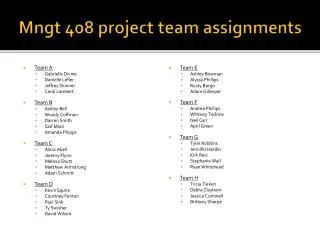
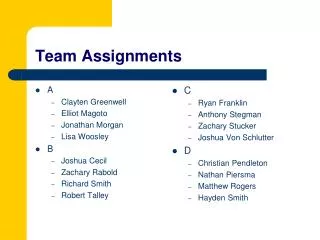
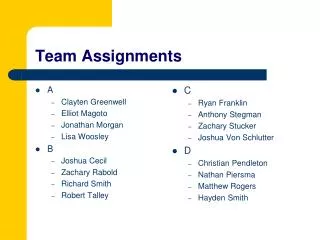
Team Assignments • A • Clayten Greenwell • Elliot Magoto • Jonathan Morgan • Lisa Woosley • B • Joshua Cecil • Zachary Rabold • Richard Smith • Robert Talley • C • Ryan Franklin • Anthony Stegman • Zachary Stucker • Joshua Von Schlutter • D • Christian Pendleton • Nathan Piersma • Matthew Rogers • Hayden Smith
Team Assignments • E • Christopher Collins • Mark Lacy • Adam Leach • Daniel Rehner • F • Cory Boughey • Matthew Broaddus • Cory Henon • Stephen Howell • G • Christopher Allison • Brett Blanchard • Travis Greenwell • Samantha Thomas
CE403 Construction Methodology Earthwork Fundamentals
LEARNING OBJECTIVES • Define the common Soil Properties and how to determine each. • Define Soil-Volume Changes that occur during earthmoving operations. • Define Swell, and Shrinkage, and how to determine the Load & Shrinkage Factors. • Define Angle of Repose for common Soil Materials. • Describe the two common Soil Classification Systems and Basic Definitions.
Soil Properties • Any mass of soil consists of solid particles with voids in between. • Soil solids are small grains of different minerals • Voids can be filled with either water or air
Soil Properties • Total volume of the soil mass, Vt, consists of volume of soil solids, Vs, and the volume of voids, Vv • The volume of the Voids, Vv, consists of volume of water, Vw, and the volume of air, Va
Soil Properties • We can schematically represent these three phases in a phase diagram. Volume Mass
Soil Properties • Three volumetric ratios • Void ratio: • Normally expressed as a decimal • Max range of e is between 0 and infinity • Typical values: Sand (0.4 to 1.0); Clays (0.3 to 1.5)
Soil Properties • Three volumetric ratios • Porosity • Normally expressed as a decimal • Max range of n is between 0 and 100%
Soil Properties • Three volumetric ratios • Degree of Saturation • The degree of saturation tells us what percentage of the total volume of voids contains water • If soil is completely dry, S=0. If the pores are completely filled with water, S=100%
Soil Properties • Mass relationships • Water (moisture) content: • Can range from zero (dry soil) to several hundred percent • Water content for most soils is well under 100%, although it can range up to 500% or higher in some marine and organic soils
Soil Properties • Mass relationships • Total density: • Magnitude will depend on amount of water in the voids and density of the mineral grains • Typical values for most soils range from 1000 to 2400 kg/m3
Soil Properties • Mass relationships • Solid density: • Typical values for most soils range from 2500 to 2800 kg/m3 (2.65 Mg/m3) • Dry Density:
Soil Properties • Mass relationships • Density of Water: • The density of water varies slightly, depending on the temperature. • For most engineering work, it is sufficiently accurate to estimate pw=1000kg/m3=62.4lb/ft3
Example Problem Given the Following: Vs=65 cm3, Vw=25 cm3, Va=10cm3 Ms = 175g, Mw=25g Find: Total Density, dry density, moisture content, void ratio, saturation, and porosity of the soil sample
Soil Volume-Change Characteristics Bank Volume - (BCY) • Material is in natural state before disturbance Loose Volume - (LCY) • Material has been excavated or loaded. Compacted Volume - (CCY) • Material after compaction.
Swell • A soil increases in volume when it is excavated because the soil grains are loosened during excavation and air fills the void spaces created.
Shrinkage • When soil is compacted, air is forced out of void spaces. • The soil will occupy less volume than it did under either bank or loose conditions.
Load & Shrinkage Example Problem A soil weighs 1,960 lb/LCY, 2,800 lb/BCY and 3,500 lb/CCY. b. How many BCY & CCY are contained in 1,000,000 LCY? Bank Volume 1,000,000 LCY x 1,960/2,800(BCY/LCY) = = 1,000,000 LCY x 0.70(BCY/LCY) = 700,000 BCY Compacted Volume 1,000,000 LCY x 1,960/3,500 (CCY/LCY)= or = 700,000 BCY x 0.80 (CCY/BCY) = 560,000 CCY
Unified Soil Classification System • Two Letter System • Symbols to represent soil type: Symbol Soil Type G Gravel S Sand M Silt C Clay Pt Highly organic soil and peat. • Symbols to represent index properties W Well-graded (for grain-size distribution) P Poorly-graded (for grain-size distribution) L Low to medium plasticity H High plasticity
Angle of Repose • The angle that the sides of a spoil bank or pile naturally form with the horizontal when the excavated soil is dumped onto a pile. • The angle varies with the soil’s physical characteristics and its moisture content.
Materials & Angle of Repose Clay 35° Common Earth, Dry 32° Common Earth, Moist 37° Gravel 35° Sand, Dry 25° Sand, Moist 37°
H D Spoil Pile Dumped from a single fixed point Volume =1/3 Base Area x Height
Basic Definitions • The liquid limit (LL) is the water content (%) at which the soil will just start to flow when subjected to standard shaking test. (Casagrande Test) • The plastic limit is the moisture content (%) at which the soil just begins to crumble when rolled into a thread 1/4” in diameter. • The plastic index is the numerical difference between the liquid and plastic limits and represents the range in moisture content over which the soil remains plastic.
Unified Soil Classification System • Two Letter System • Symbols to represent soil type: Symbol Soil Type G Gravel S Sand M Silt C Clay Pt Highly organic soil and peat. • Symbols to represent index properties W Well-graded (for grain-size distribution) P Poorly-graded (for grain-size distribution) L Low to medium plasticity H High plasticity
AASHTO Soil Classification System • American Association of State Highway and Transportation Officials • A-1 through A-7 • Table 2-3, Page 25.
Construction Characteristics of Soils • Drainage • Construction Workability • Suitability for Subgrade • Suitability for Surfacing